

Isolation Gowns Explained: Levels and When Each Is Used
Nov 16th 2026
Isolation gown levels describe how much liquid a gown resists. ANSI/AAMI PB70 classifies gowns from Level 1 (minimal barrier) to Level 4 (highest barrier). "Isolation gown" and "surgical gown" are garment categories, not protection levels, so always check the level printed on the label and follow your facility's risk assessment and protocol.
Isolation, Surgical, and Non-Surgical Gowns
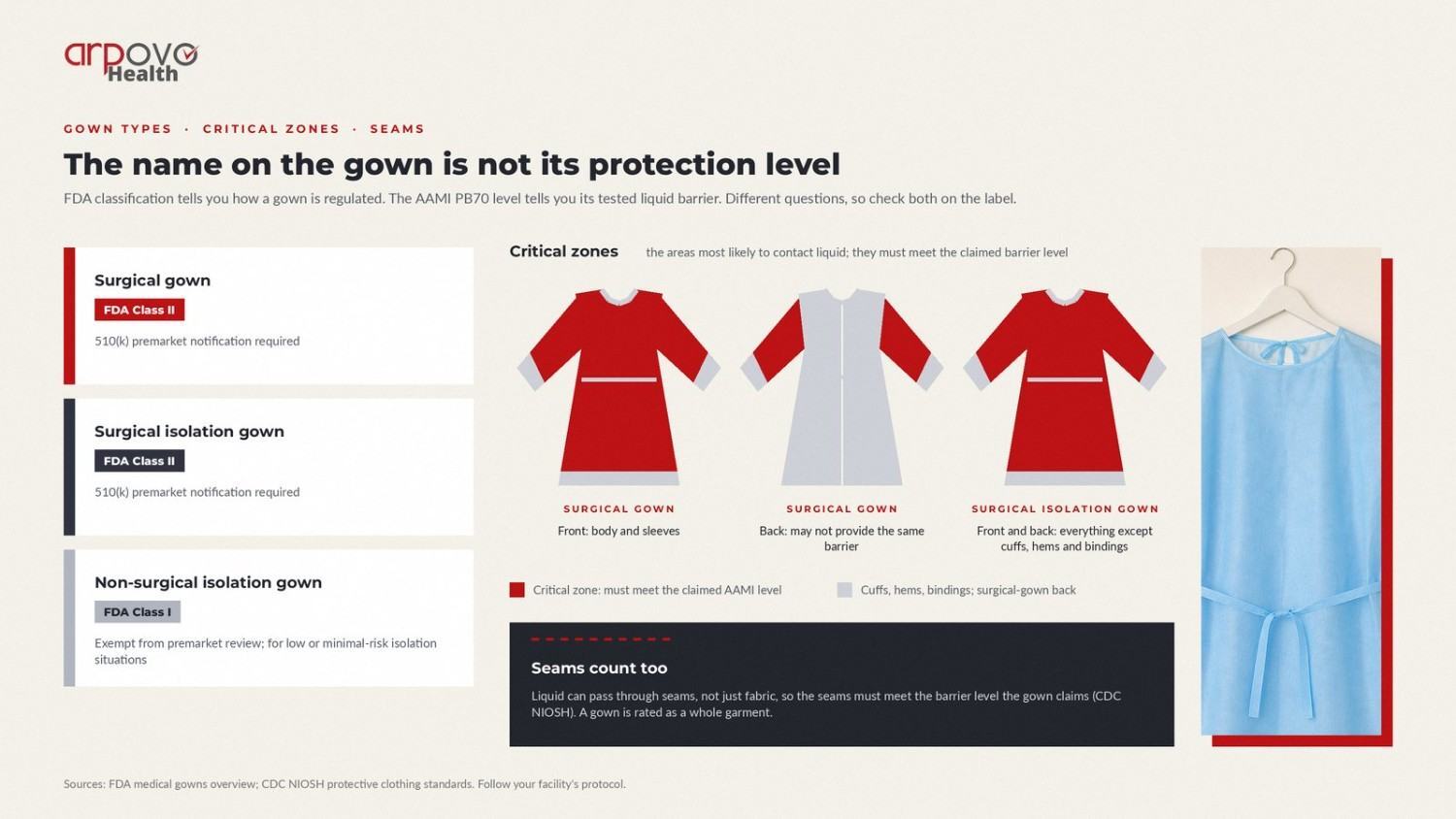
Gown names alone do not establish barrier performance. The FDA recognizes several gown types, and each is regulated differently:
- Surgical gowns: Class II medical devices requiring 510(k) premarket notification.
- Surgical isolation gowns: Class II devices, also requiring 510(k) notification.
- Non-surgical isolation gowns: Class I devices, exempt from premarket review, intended for low or minimal-risk isolation situations.
FDA classification describes how a device is regulated. An AAMI level describes its tested liquid-barrier performance. These labels answer different questions, so check both.
What the AAMI Levels Mean
AAMI PB70 uses standardized tests to measure resistance to liquid penetration. Level 1 uses a water impact test, Levels 2 and 3 add hydrostatic pressure testing, and Level 4 adds testing with synthetic blood and viral penetration.
|
Level |
Barrier |
Example situations (AAMI / FDA) |
|
Level 1 |
Minimal |
Basic care, standard isolation, visitor cover gowns |
|
Level 2 |
Low |
Blood draws, suturing, ICU, pathology laboratories |
|
Level 3 |
Moderate |
Arterial blood draws, IV insertion, emergency rooms, trauma cases |
|
Level 4 |
High; adds blood and viral penetration testing |
Long, fluid-intensive procedures, surgery, situations requiring additional resistance to blood-borne pathogen penetration |
These are examples from AAMI and FDA descriptions, not rules. Higher levels mean greater tested barrier resistance, but they do not guarantee protection under every working condition.
Critical Zones and Seams
Critical zones are the gown areas most likely to contact liquids. For traditional surgical gowns, they include the front of the body and the sleeves, and the back may not provide the same barrier. Surgical isolation gowns have broader critical zones, covering everything except cuffs, hems, and bindings.
Seams matter too. Liquid can pass through seams, not just fabric, so seams must meet the gown's claimed barrier level. See CDC NIOSH's protective clothing standards for details.
Which Level for Which Situation
The right level depends on the expected liquid exposure and the task. Use the table above as a starting point, not a rule. Your facility's risk assessment, infection-prevention team, and protocol decide the required level.
Fit and Coverage Matter Too
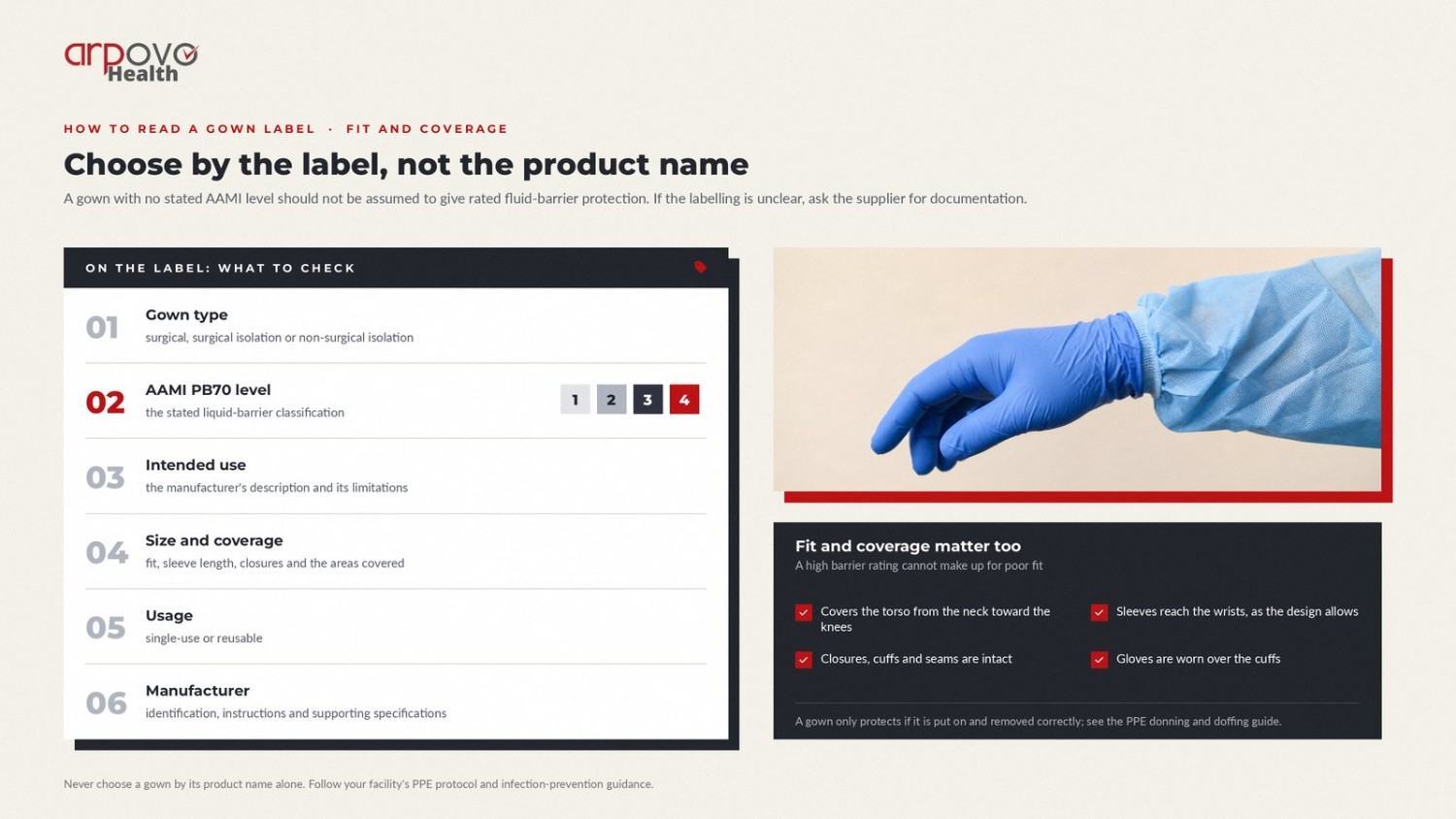
A high barrier rating cannot make up for poor fit or coverage. Check that the gown covers your torso from the neck toward the knees and that the sleeves reach your wrists, as the design allows. Closures, cuffs, seams, and gloves worn over the cuffs also matter.
A gown only protects if it is put on and removed correctly. See our PPE donning and doffing order guide for the example sequence.
How to Read a Gown Label
Never choose a gown by its product name alone. Check these details:
- Gown type: surgical, surgical isolation, or non-surgical isolation.
- AAMI PB70 level: the stated liquid-barrier classification.
- Intended use: the manufacturer's description and limitations.
- Size and coverage: fit, sleeves, closures, and covered areas.
- Usage: single-use or reusable.
- Manufacturer: identification, instructions, and supporting specifications.
A gown with no stated AAMI level should not be assumed to give rated fluid-barrier protection. Ask the supplier for documentation if the labeling is unclear.
Related PPE
Gowns are one part of a protective setup. For hand and face protection, read our nitrile vs latex vs vinyl exam gloves comparison and our surgical mask vs N95 vs KN95 guide.
Frequently Asked Questions
What do AAMI gown levels mean?
AAMI PB70 grades liquid-barrier performance from Level 1 (minimal) to Level 4 (highest). The level describes tested liquid resistance, not overall garment quality.
What is the difference between an isolation gown and a surgical gown?
Surgical gowns and surgical isolation gowns are FDA Class II devices requiring 510(k) notification. Non-surgical isolation gowns are Class I devices intended for minimal or low-risk isolation situations.
What level of isolation gown do I need?
It depends on the task and the expected fluid exposure. Level 1 suits basic care, and higher levels suit tasks with greater exposure risk. Follow your facility's protocol.
Is a higher gown level always better?
Not automatically. Higher levels offer greater tested liquid resistance, but the correct choice depends on the task. Follow your facility's exposure assessment and requirements.
Can I rely on the name "isolation gown" alone?
No. Gown names do not establish barrier performance. Check the label for the gown type, AAMI level, intended use, and manufacturer information.
Choosing PPE starts with matching equipment to the task. Browse Arpovo Health's personal protective equipment for nitrile gloves, Dr. Myfan KN95 masks, and disposable three-layer earloop masks.
This article is for general educational purposes and isn't a substitute for training or guidance from your employer, infection-prevention team, or healthcare provider. Follow your facility's PPE protocol.