
How Accurate Are Home Glucose Meters? Understanding Testing Error Margins
Nov 4th 2026
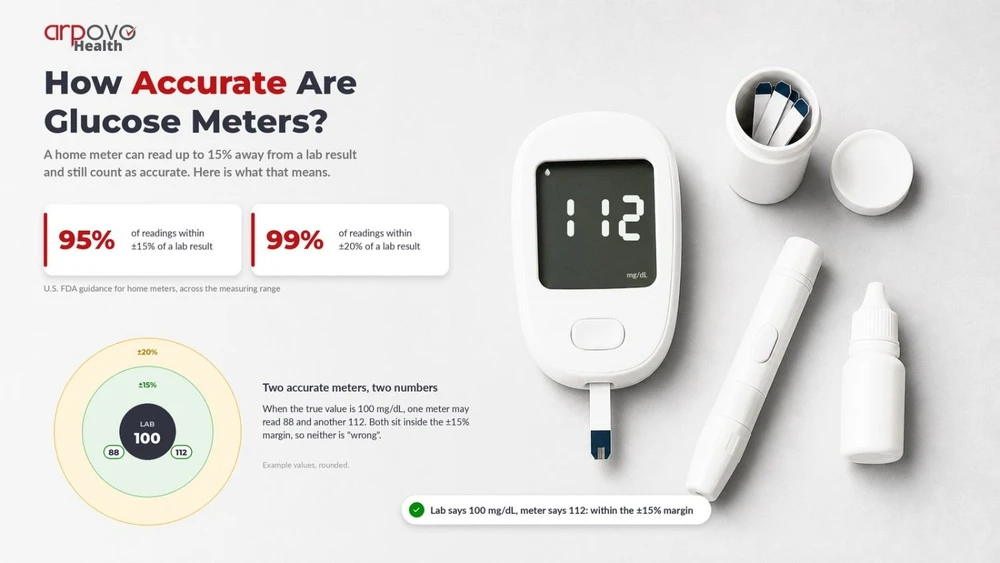
Home glucose meters are accurate enough for everyday blood sugar checks, but they are allowed a built-in margin of error. A reading is a close estimate, not an exact number. In the U.S., FDA guidance recommends that manufacturers show 95% of readings fall within 15% of a lab result, and 99% within 20%, across the meter's measuring range. So a reading that sits a little away from your lab result is normal. Here is what that margin looks like, why readings differ, and how to check your own meter.
What 15% Looks Like in Real Numbers
An error margin is how far a meter reading may sit from the true value. If your lab result is 100 mg/dL, a meter reading between 85 and 115 mg/dL is within the 15% margin. That is why two accurate meters can show different numbers at the same moment. One might read 88 and the other 112, and both are within the margin.
|
Lab (true) value |
Allowed margin |
Meter may read between (95% of readings) |
Meter may read between (99% of readings) |
|
70 mg/dL |
±15% (±20%) |
About 60–80 mg/dL |
About 56–84 mg/dL |
|
100 mg/dL |
±15% (±20%) |
85–115 mg/dL |
80–120 mg/dL |
|
150 mg/dL |
±15% (±20%) |
About 128–173 mg/dL |
120–180 mg/dL |
|
250 mg/dL |
±15% (±20%) |
About 213–288 mg/dL |
200–300 mg/dL |
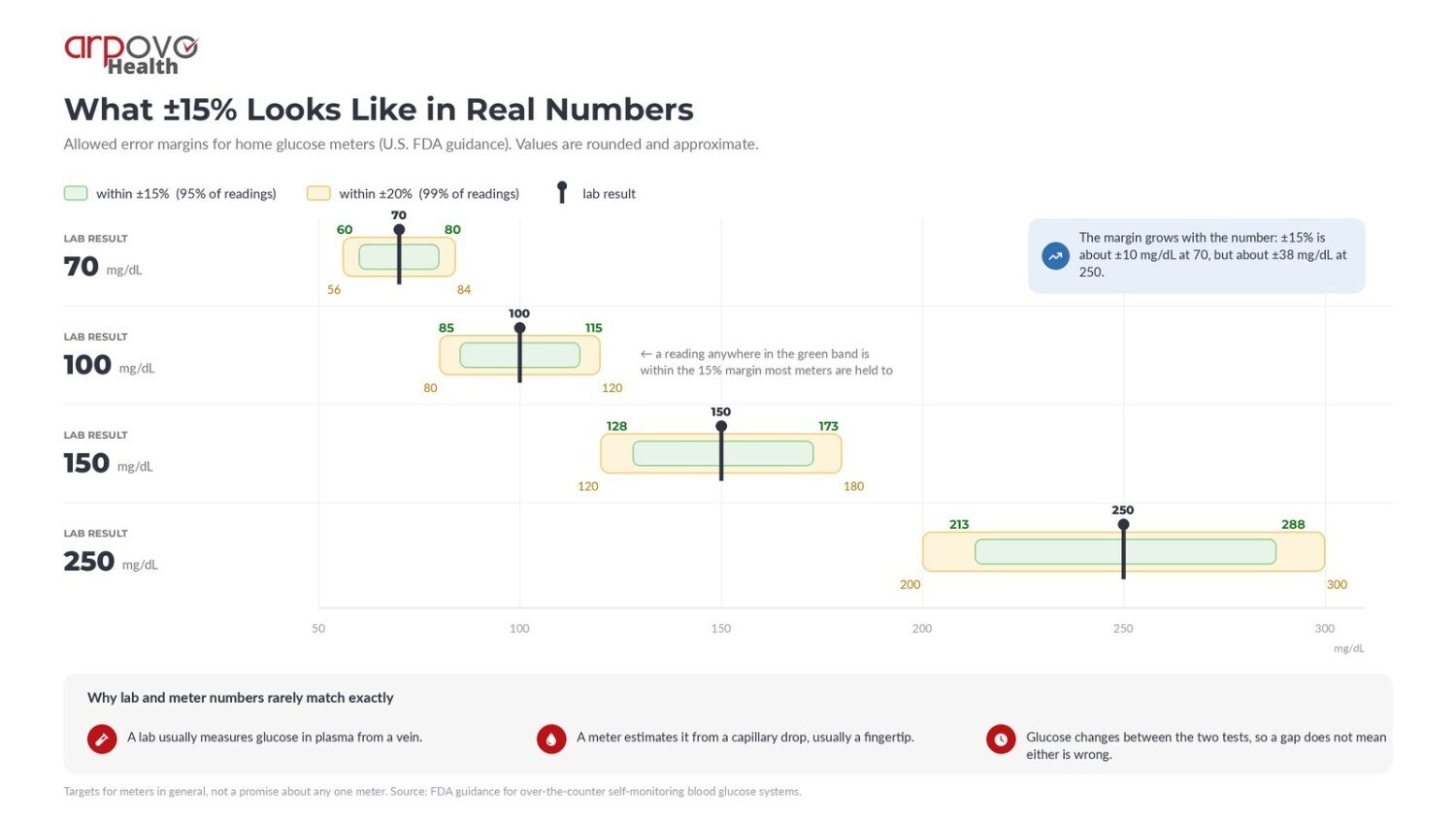
Values are rounded and approximate. These are targets for meters in general, not a promise about any one meter.
Why Readings Differ
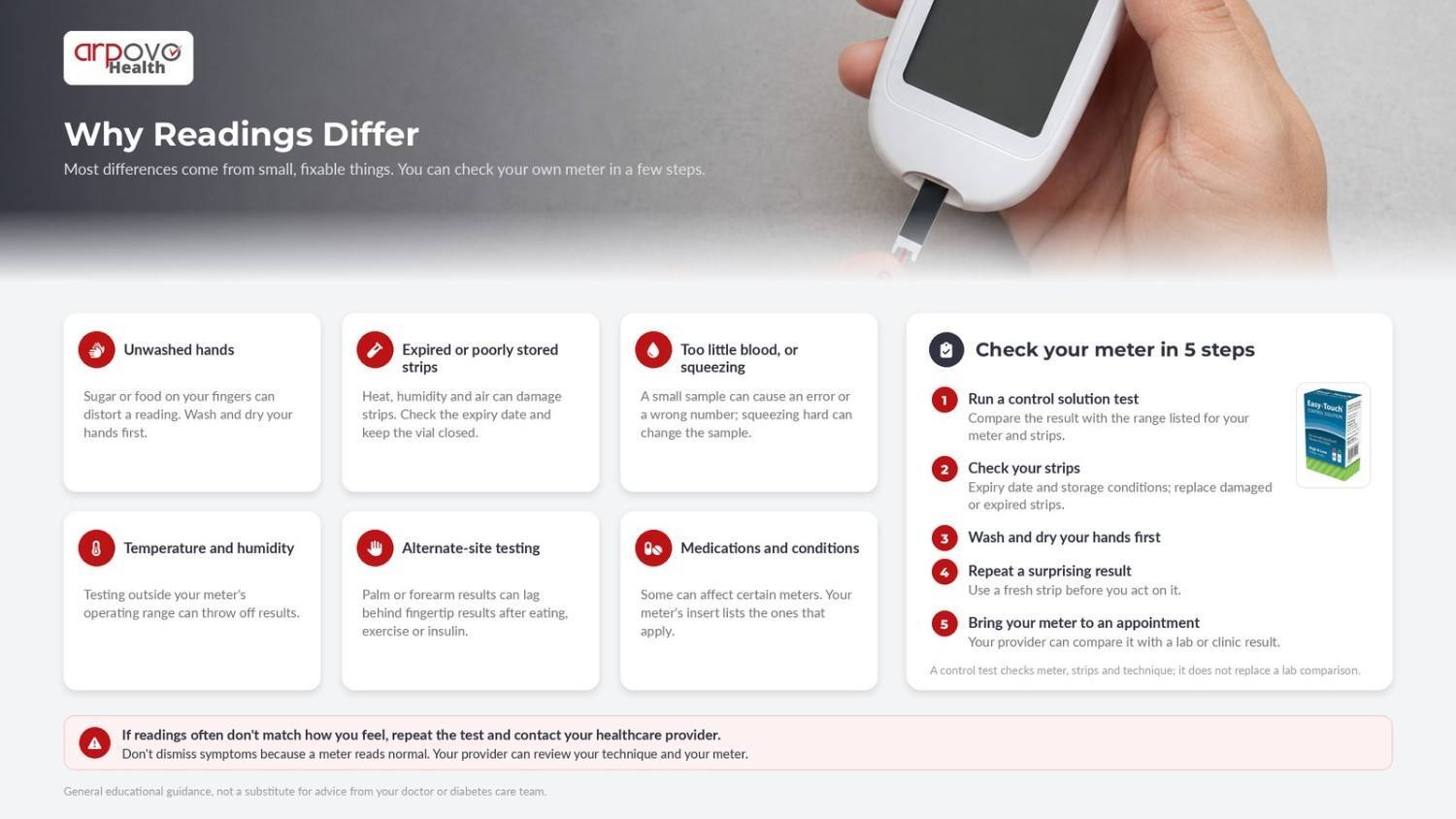
Most differences come from small, fixable things:
- Unwashed hands: Sugar or food on your fingers can distort a reading. Wash and dry your hands first.
- Expired or poorly stored strips: Heat, humidity, and air can damage strips. Check the expiry date and keep the vial closed.
- Too little blood, or squeezing: A small sample can cause an error or a wrong number. Squeezing your finger hard can also change the sample.
- Temperature and humidity: Testing outside your meter's operating range can throw off results.
- Alternate-site testing: Palm or forearm results can lag behind fingertip results after eating, exercise, or insulin.
- Medications and health conditions: Some can affect certain meters. Your meter's insert lists the ones that apply.
Lab Results vs. Meter Readings
Labs and home meters don't measure in the same way. A lab usually measures glucose in plasma from a vein. Your meter estimates it from a small drop of capillary blood, usually from a fingertip.
Timing matters too. Your glucose can change between your home test and the blood draw, so the two numbers are rarely taken at the same moment. A gap between them doesn't mean either one is wrong.
How to Check Your Own Meter
You can check your meter's basic performance in a few steps:
- Run a control solution test. Follow the manufacturer's directions and compare the result with the range listed for your meter and strips.
- Check your strips. Look at the expiry date and storage conditions. Replace damaged or expired strips.
- Wash and dry your hands first.
- Repeat a surprising result. Use a fresh strip before you act on it.
- Bring your meter to an appointment. Your provider can compare it with a lab or clinic result.
Arpovo carries the EasyTouch High/Low Control Solution, which is intended for use with EasyTouch meters. A control test checks the meter, the strips, and your technique. It doesn't replace a comparison with a lab result. If you are choosing a meter, our EasyTouch vs HealthPro guide covers features, and our glucose test strip buyer's guide covers what to look for in strips.
When to Talk to Your Provider
If your readings often don't match how you feel, or a reading seems out of line, repeat the test and contact your healthcare provider. Don't dismiss symptoms because a meter reads normal. Your provider can review your testing technique and your meter.
Frequently Asked Questions
How accurate are home glucose meters?
In the U.S., FDA guidance recommends that 95% of readings fall within 15% of a laboratory result and 99% within 20%. That means a reading is a close estimate, not an exact value.
Why is my meter different from my lab result?
Meters have an allowed margin of error. Labs usually measure venous plasma, while meters use a drop of capillary blood. Timing, hand washing, strip condition, and sample size also matter.
Can two accurate meters show different numbers?
Yes. If the true value is 100 mg/dL, one meter could read 88 and another 112, and both would be within a 15% margin.
How can I tell if my meter is working correctly?
Use control solution as the manufacturer directs, check strip expiry and storage, and wash and dry your hands. Bring the meter to an appointment so your provider can compare it with a lab or clinic result.
Does an expired test strip affect accuracy?
Yes. Expired strips, or strips exposed to heat, humidity, or air, can give unreliable readings. Always check the expiry date and storage instructions.
Looking for glucose monitoring supplies? Browse Arpovo Health's Diagnostic Instruments and Supplies for meters, strips, and related testing products.
This article is for general educational purposes and isn't a substitute for advice from your doctor or diabetes care team. If your meter readings don't match how you feel, repeat the test and contact your healthcare provider.