
Sharps Disposal Rules by State: A Complete 2026 Guide
Jul 20th 2026
Sharps disposal rules by state are not the same everywhere. Some states, like Massachusetts, prohibit placing used needles in household trash entirely. Others allow it only as a last resort, and only inside a sealed, approved container. A handful of states have no specific rule for home users at all. Federal guidance from the FDA sets safety standards for containers, but it does not set one national rule, so your actual obligation depends on where you live. This guide breaks down the three patterns state rules generally follow, verified real-world examples of each, and exactly how to find your own state's current requirement. If you need the basic contained-disposal steps first, the guide to safely disposing of used needles and syringes covers that ground in detail.
Is It Illegal to Throw Away Needles?
Whether it is illegal to throw away needles depends entirely on your state. Some states ban home sharps from household trash outright. Others discourage the practice but allow it as a last resort if the sharps are properly contained. A few states have no specific rule for home users at all.
Who Regulates Sharps Disposal?
Three federal bodies play a role, but none of them directly enforces household disposal. The FDA sets safety standards for sharps containers and publishes disposal guidance for consumers, though it does not regulate what a household does with its own used needles. OSHA governs sharps generated in workplaces, such as clinics and hospitals, not private homes. The EPA offers waste-management guidance to states and local governments rather than writing household rules itself.
That gap is exactly why enforcement of home-generated sharps falls to the states, and sometimes down to individual counties or cities. It is also why the rules below can look so different depending on which side of a state line you live on. In practice, this means the question "is this legal where I live" almost always has to be answered by a state or county agency, not a federal one.
The Three Types of State Rules
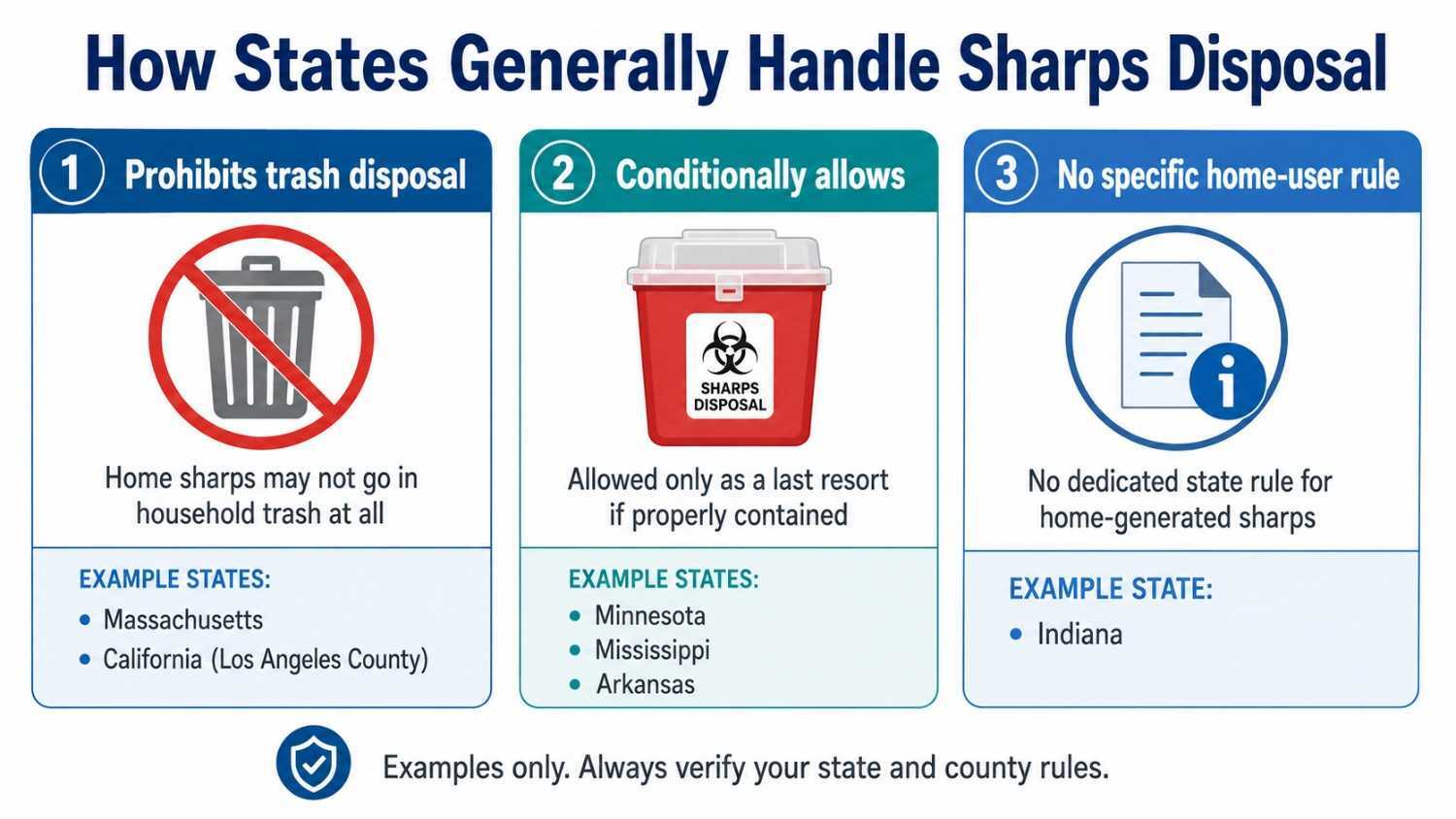
State approaches generally fall into three groups: states that prohibit trash disposal outright, states that discourage it but conditionally allow it, and states with no specific rule for home-generated sharps at all.
|
Category |
What it generally means |
Examples states |
|
Prohibits trash disposal |
Home sharps may not go in household trash at all |
Massachusetts, California (Los Angeles County) |
|
Discourages but conditionally allows |
Permitted only as a last resort, and only if properly contained (or, in some states, disinfected first) |
Minnesota, Mississippi, Arkansas |
|
No specific home-generator rule |
No dedicated state law addresses home sharps disposal |
Indiana |
States that prohibit trash disposal
Massachusetts has banned home sharps from municipal solid waste since July 2012, under a state sanitary code provision specifically covering home sharps. Residents there must use an approved collection program, a community drop-off site, or a mail-back service instead. California takes a related approach through a statewide sharps stewardship law that funds free take-back and mail-back options for residents, and local jurisdictions build on that law with their own rules; Los Angeles County, for example, directly instructs residents not to place sharps waste in the trash, green waste, or recycling bin.
States that discourage trash disposal but conditionally allow it
Minnesota's state guidance discourages placing sharps in household trash for safety reasons, but permits it as a last resort if a collection site or mail-back option is not practical, and only inside a container that is labeled, closed, and taped shut. Sharps can never go into recycling there, no matter how they are packaged. Mississippi takes a similar stance: throwing syringes in household trash is not illegal in the state, but the environmental agency recommends free local drop-off programs as the safer choice. Arkansas also allows trash disposal, but only after an extra step many other states do not require: sharps must be chemically disinfected first, typically by soaking them for ten minutes in a solution of one part bleach to ten parts water, before they can go into regular household waste.
States with no specific home-generator rule
Indiana's environmental agency confirms directly that sharps disposal by home self-injectors is not a regulated activity in the state. State guidance still recommends safe handling, since the absence of a specific law does not make loose sharps in the trash a safe idea. Even in states like Indiana, individual counties sometimes run their own solid waste districts that only accept properly contained, FDA-approved sharps containers at local drop-off points, so a lack of state regulation does not always mean a lack of local guidance.
Your Disposal Options, No Matter Where You Live
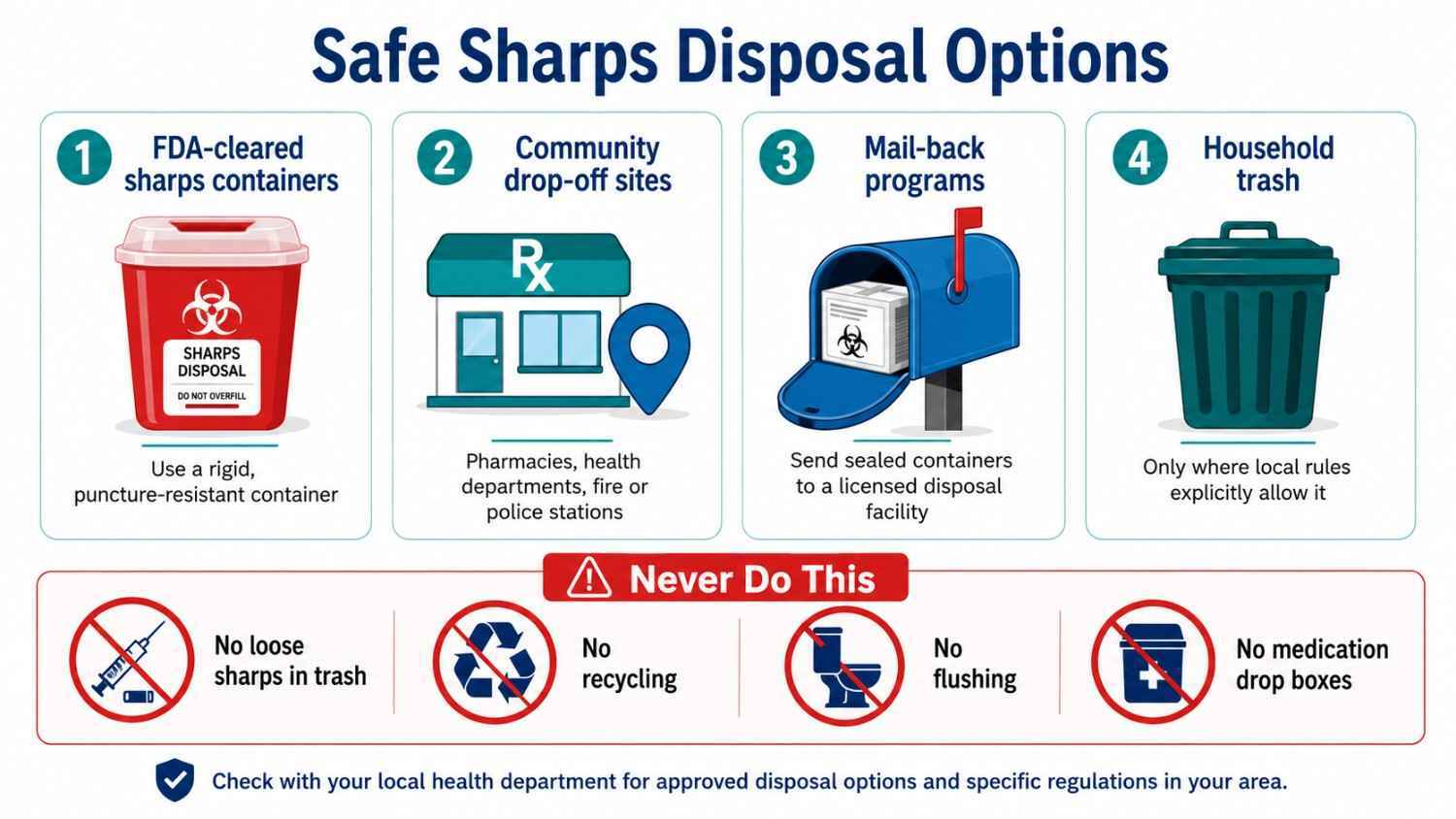
Regardless of your state's specific rule, four disposal options are available in almost every part of the country: sharps containers, community drop-off sites, mail-back programs, and household trash only where it is explicitly allowed.
- FDA-cleared sharps containers: rigid, puncture-resistant containers built specifically for used needles, available through pharmacies, medical supply stores, and online.
- Community drop-off sites: pharmacies, fire and police stations, and health departments often accept filled sharps containers at no cost, though hours and accepted volumes vary by location.
- Mail-back programs: a USPS-compliant mail-back sharps program lets you seal a container and ship it directly to a licensed disposal facility; manufacturer-funded programs are often free, while some private services charge a per-container fee.
- Household trash: only where your state or county explicitly allows it, and only inside an approved, labeled container, never loose.
If you have not settled on a container type yet, the guide to safety syringes versus standard syringes covers FDA container recommendations and the risks of skipping them in more depth. And for the full step-by-step process, from filling a container to sealing it for pickup, see the complete guide on how to safely dispose of used needles and syringes.
How to Find Your State's Specific Rule
Since sharps rules can vary by county as well as by state, the most reliable source is your own state or county health department's website. Search your state health department or environmental agency website directly for guidance on how to dispose of used needles at home in your area, since many states maintain dedicated documentation for household sharps. The FDA's sharps disposal guidance is a solid starting point too, and it applies no matter which state you are checking rules for.
If you are ordering insulin syringes or other home injection supplies, it is worth checking your local needle disposal by state rule at the same time, so you already know your disposal plan before your first sharp is ever used.
What Never to Do
- Never place loose sharps directly in the trash, even briefly.
- Never put a sharps container in the recycling bin.
- Never flush needles or lancets down the toilet.
- Never place sharps in a medication take-back drop box; those are built for pills, not needles.
If you are stocking up on injection supplies, browse Arpovo Health's full needles and syringes catalog for current options, and pair your order with the complete guide to safely disposing of used needles and syringes so your disposal plan is ready before you need it.
Frequently Asked Questions
Is it illegal to throw needles in the trash?
It depends entirely on your state. Some states, like Massachusetts, ban it outright. Others discourage it but allow it as a last resort if properly contained. A few states have no specific rule for home users at all.
What's the safest way to dispose of used needles at home?
Place them immediately in an FDA-cleared sharps container, then use a community drop-off site or a mail-back program once the container is about three-quarters full.
Can I mail my used sharps container?
Yes, through mail-back programs that comply with USPS regulations for mailing regulated medical waste. Follow the specific container manufacturer's instructions for labeling and shipping.
Where can I find the exact rule for my state?
Check your state or county health department's website, or start with the FDA's sharps disposal resources, since rules can also vary by county within a state.
What if my state has no specific sharps disposal law?
Even without a specific law, safe practice is the same everywhere: use an approved container, never place loose sharps in the trash, and use a community drop-off or mail-back option if one is available.
Can I put a sharps container in the recycling bin?
No, sharps containers should never go in recycling, regardless of your state's trash rules; they must go through an approved disposal method or program.
(This article is for general informational purposes and is not legal advice. Sharps disposal rules vary by state and county and can change. Always confirm current requirements with your state or local health department before disposing of medical waste.)