
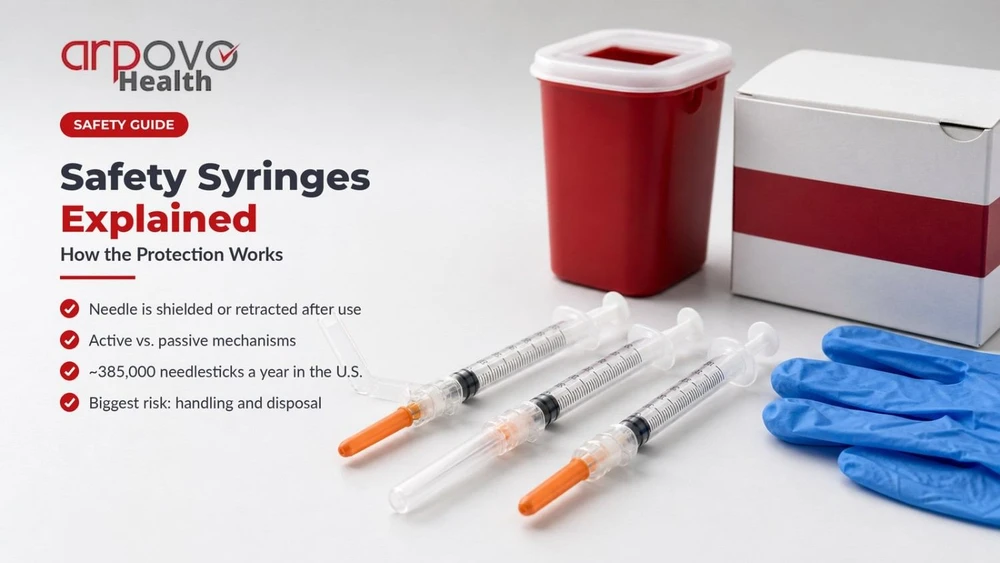
Safety Syringes Explained: How FlipLock and Fluringe Protect Caregivers
Oct 5th 2026
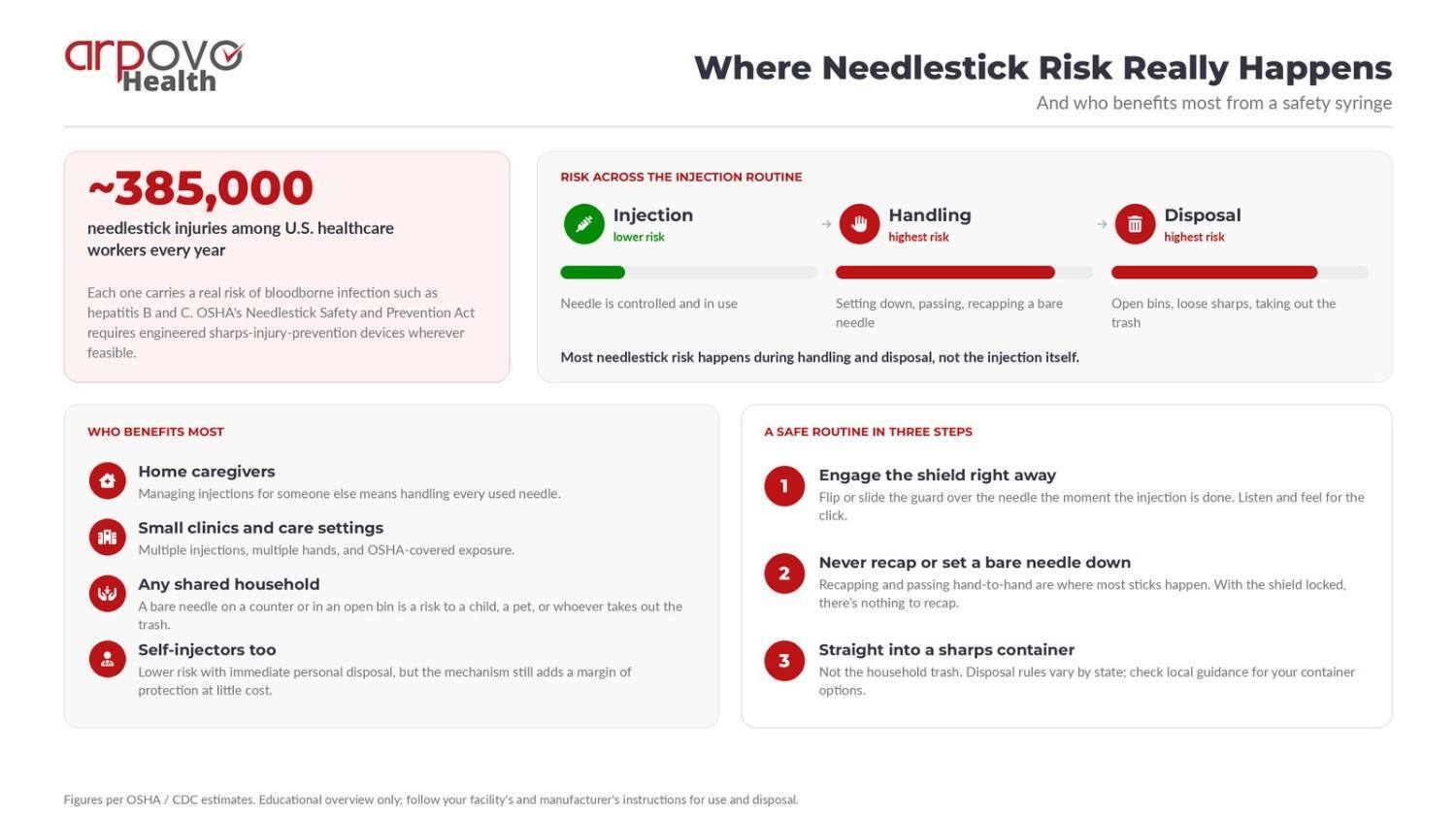
The core difference in a safety syringe vs. standard syringe comparison is a built-in mechanism that shields or retracts the needle immediately after use. That difference exists for a real reason: roughly 385,000 needlestick injuries happen among U.S. healthcare workers each year, carrying a real risk of bloodborne infections like hepatitis B and C. OSHA's Needlestick Safety and Prevention Act requires engineered sharps-injury-prevention devices wherever feasible. Safety syringes, sometimes called a needlestick prevention syringe, aren't a premium add-on; they're a direct response to a documented, common injury. In practice, that means most syringes sold for clinical and caregiving use today are safety-engineered by default, not by special request.
How the Mechanisms Actually Work
Three mechanism types cover most of what's on the market, split into two broader categories: active and passive.
|
Mechanism Type |
How It Works |
Activation |
|
Sliding sheath / hinged guard (e.g., FlipLock-style) |
A hinged or sliding shield locks over the needle immediately after the injection |
Active, the user completes a deliberate motion to engage it |
|
Retractable needle |
The needle withdraws into the syringe barrel after use |
Can be active (manual trigger) or passive (automatic on full plunger depression) |
|
Auto-disable |
An internal mechanism blocks the plunger from being pulled back or reused after one injection |
Automatic on full depression; prevents reuse, not always paired with needlestick shielding |
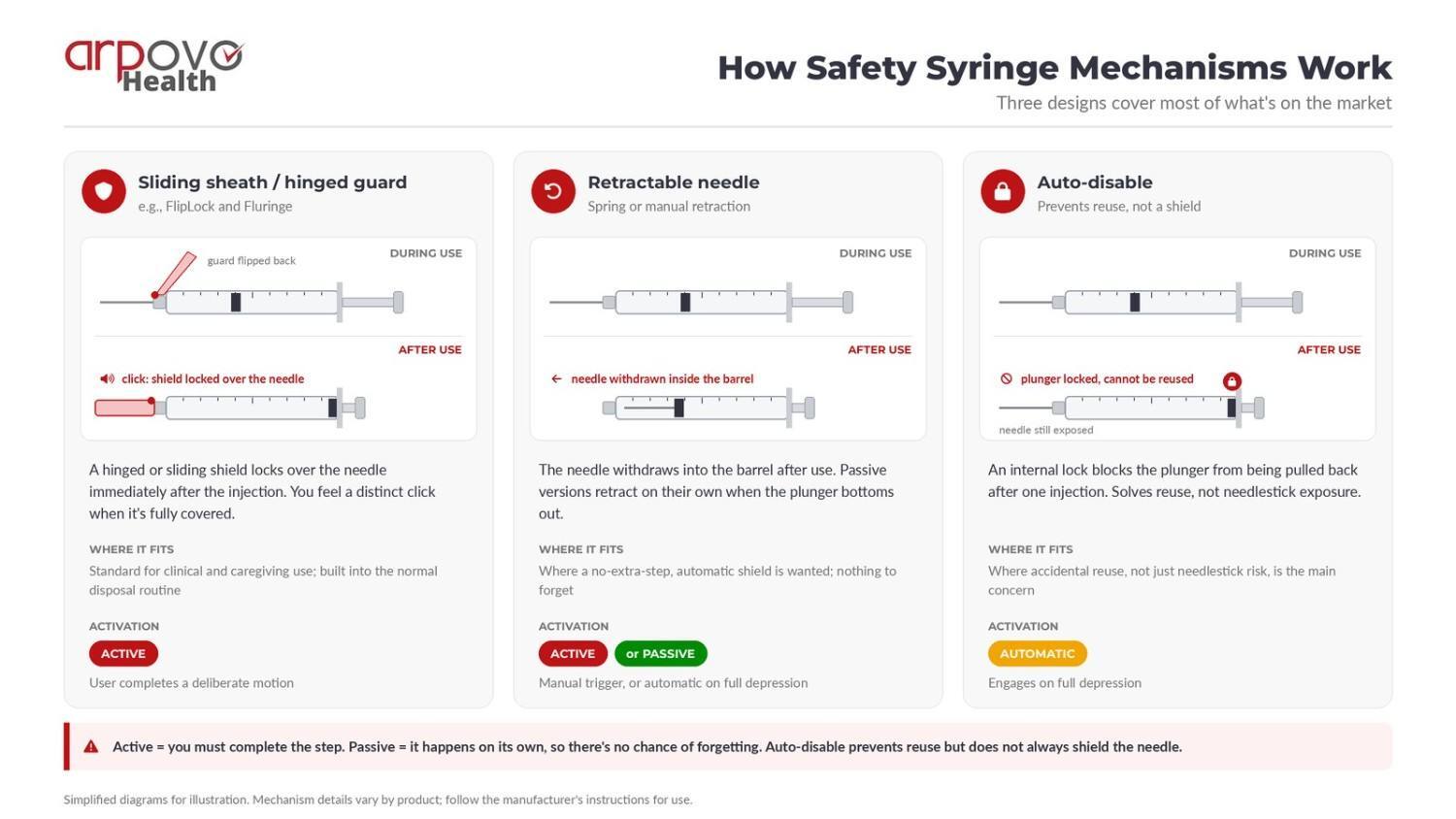
Active mechanisms require you to complete a deliberate motion, like sliding a shield or engaging a hinge, to activate the protection. Passive mechanisms, such as a retractable needle syringe that withdraws on its own once the plunger bottoms out, engage automatically, without a separate step, which removes any chance of forgetting to activate it. Auto-disable mechanisms solve a related but different problem: instead of shielding the needle, they physically block the syringe from being reused at all once the plunger is fully depressed, which matters most where accidental reuse, not just needlestick risk, is the concern.
FlipLock and Fluringe: What These Specific Designs Do
FlipLock and Fluringe, EasyTouch's safety syringe lines, both use the hinged or sliding-shield design, the sliding sheath category from the table above. After the injection, you engage a hinged guard or sliding sheath that locks in place over the needle, fully covering the point before the syringe is set down or disposed of. It's a deliberate, one-motion step built into the normal disposal routine, not an extra task tacked onto the end. You'll feel a distinct click or catch when the shield locks fully into place, your confirmation that the needle is covered before you set the syringe down.
Do You Actually Need a Safety Syringe?
Anyone in a caregiving role handling used needles benefits most from a safety syringe. Home caregivers, small clinics, and anyone managing injections for someone else face the highest risk, since most needlestick risk happens during handling and disposal, not the injection itself. That's also exactly where safe sharps disposal becomes the natural next question: once the syringe itself is designed to protect you, how you get rid of it matters just as much. A single person self-injecting with immediate personal disposal has a different risk profile, though the mechanism still adds a margin of protection at no real downside beyond incremental cost. Even at home, a used needle left on a counter or in an open trash bin poses a real risk to anyone else who encounters it, a child, a pet, or whoever takes out the trash, which is a low-probability event for any single household but a cheap one to guard against.
Ready to add a safety mechanism to your routine? Browse Arpovo Health's syringes with needles selection, including FlipLock and Fluringe options. If you're also still working out needle gauge, the insulin syringe gauge guide covers that separately.
Frequently Asked Questions
What makes a safety syringe different from a standard syringe?
A safety syringe has a built-in mechanism, a sliding sheath, hinged guard, or retractable needle, that covers or withdraws the needle immediately after use, reducing the risk of an accidental needlestick during handling or disposal.
Are safety syringes required by law?
OSHA's Needlestick Safety and Prevention Act requires employers with occupational exposure to use engineered sharps-injury-prevention devices wherever medically feasible, which in practice means safety syringes are standard in most clinical settings.
What's the difference between an active and passive safety mechanism?
Active mechanisms require the user to complete a deliberate step (like sliding a shield) to engage protection. Passive mechanisms activate automatically, such as a needle that retracts on its own once the plunger is fully depressed.
Do I need a safety syringe if I'm just injecting myself at home?
The risk is lower for self-injection with immediate personal disposal, but a safety syringe still adds a margin of protection, especially if anyone else in the household might handle a used syringe.
Why do safety syringes cost more than standard syringes?
The added mechanism (sheath, hinge, or retraction system) requires more manufacturing complexity than a standard syringe, which is reflected in the price, weighed against the real cost and risk of a needlestick injury.