
IV Catheter Gauge Color Guide: What Each Color Means
Oct 13th 2026
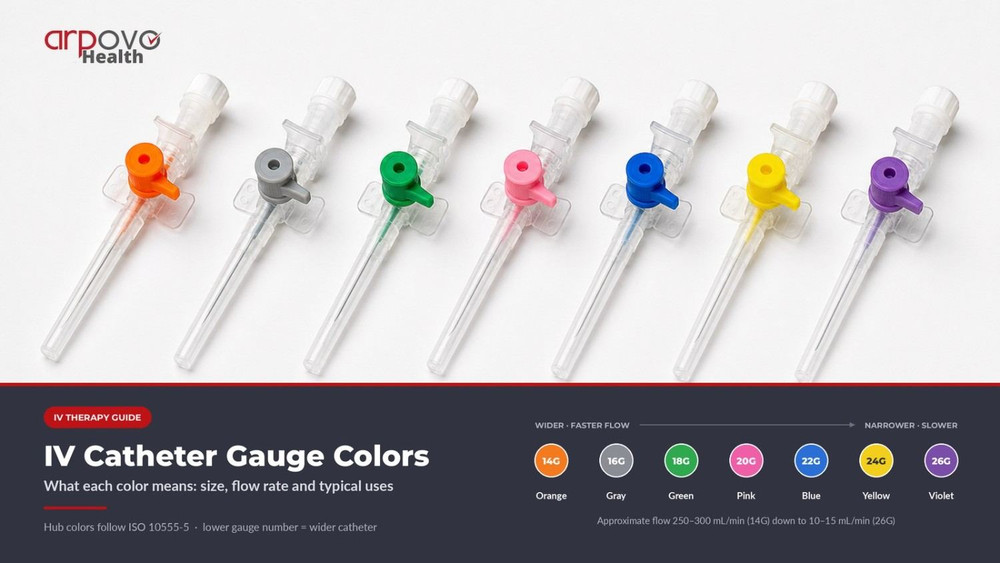
IV catheter gauge colors help healthcare professionals identify catheter sizes quickly. For example, 18G is green, while 20G is pink. Orange identifies 14G catheters, and yellow identifies 24G catheters. Each size supports different clinical needs, depending on vein condition, prescribed therapy, and required flow. This guide explains the standard color code, approximate flow rates, and common uses.
Why IV Catheters Are Color-Coded
Color-coded catheter hubs help clinical staff recognize gauge sizes quickly and reduce selection errors. Common peripheral IV catheter colors follow ISO 10555-5 conventions. However, always confirm the printed gauge before choosing a device. The two most common reference questions are straightforward:
- What color is an 18 gauge IV? Green.
- What color is a 20 gauge IV? Pink.
These colors support quick identification in clinical settings. However, the color alone does not confirm that a catheter suits every patient or treatment.
How Gauge Works
Gauge describes the catheter's approximate outside diameter. A lower gauge number means a wider catheter, while a higher number means a narrower catheter.
For example, a 14G catheter has a wider diameter than a 24G catheter. Wider catheters can support faster flow under comparable conditions.
Remember that the IV cannula color code differs from hypodermic needle colors. Hypodermic needles use a separate system covered by ISO 6009. Never use a needle color chart to identify an IV catheter.
IV Gauge Color Chart
Use this IV gauge color chart to identify common catheter sizes, their approximate diameters, and typical applications.
|
Gauge |
Color |
Outer Diameter |
Approximate Flow Rate |
Typical Use |
|
14G |
Orange |
~2.0 mm |
~250–300 mL/min |
Trauma, rapid volume replacement, large surgical cases |
|
16G |
Gray |
~1.8 mm |
~180 mL/min |
Surgery, rapid fluid replacement, blood products |
|
18G |
Green |
~1.2–1.3 mm |
~90 mL/min |
Blood products, contrast injection, general adult access |
|
20G |
Pink |
~1.0–1.1 mm |
~60 mL/min |
Routine adult infusions and medications |
|
22G |
Blue |
~0.8–0.9 mm |
~36 mL/min |
Older adults, children, small or fragile veins |
|
24G |
Yellow |
~0.7 mm |
~20 mL/min |
Neonates, small children, fragile veins, slower infusions |
|
26G |
Violet |
~0.6 mm |
~10–15 mL/min |
Very small veins and selected neonatal settings |
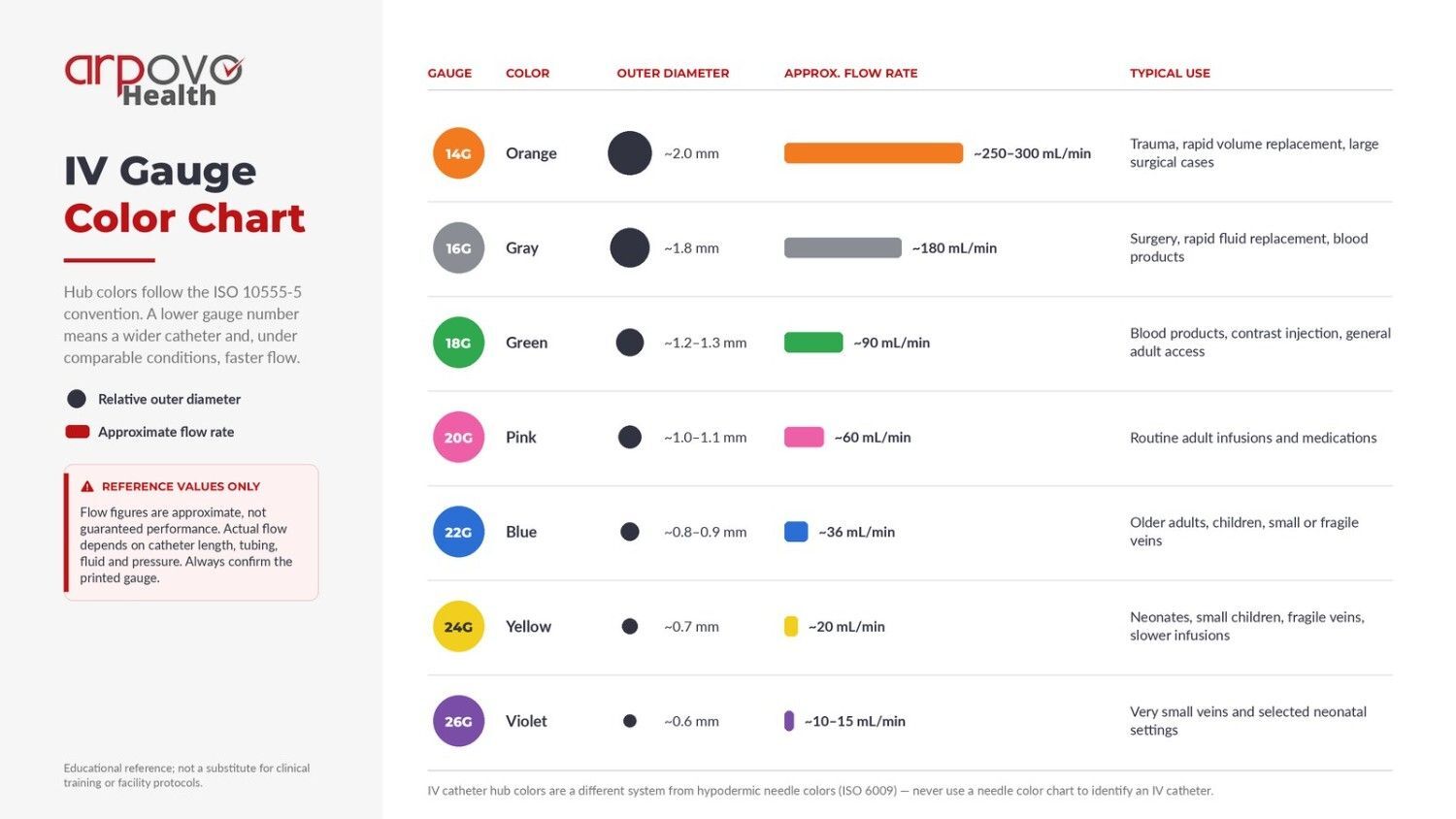
Important: These IV gauge flow rate figures are approximate reference values, not guaranteed clinical performance. Manufacturer data can differ, even within a single product line. For example, BD lists a 20G Insyte Autoguard catheter at 63 mL/min in a 1.00-inch length and 54 mL/min in a 1.88-inch length.
Actual flow depends on catheter length, tubing, fluid properties, pressure, and the device design. Always check the manufacturer's specifications before relying on a flow figure.
Choosing the Right Gauge
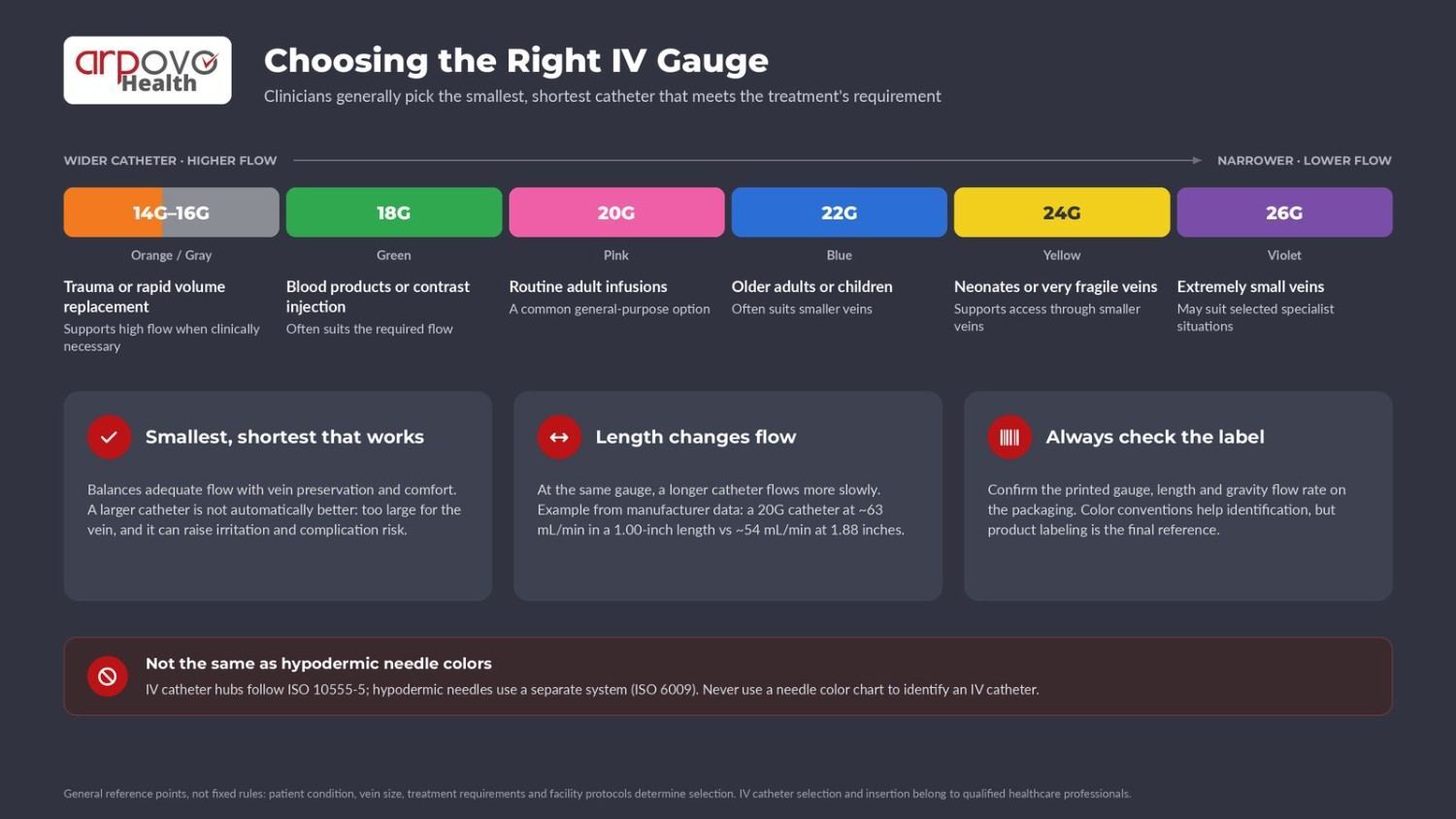
Healthcare professionals generally select the smallest, shortest catheter that meets the treatment's requirements. This approach balances adequate flow with vein preservation and patient comfort. Length matters as well: at the same gauge, a longer catheter generally flows more slowly, as the example above shows.
|
Clinical Requirement |
Common Gauge to Consider |
Reason |
|
Trauma or rapid volume replacement |
14G–16G |
Supports high flow when clinically necessary |
|
Blood products or contrast injection |
18G |
Often suits the required flow |
|
Routine adult infusions |
20G |
A common general-purpose option |
|
Older adults or children |
22G |
Often suits smaller veins |
|
Neonates or very fragile veins |
24G |
Supports access through smaller veins |
|
Extremely small veins |
26G |
May suit selected specialist situations |
These are general reference points, not fixed rules. Patient condition, vein size, treatment requirements, and facility protocols determine the final selection.
A larger catheter is not automatically better. If the catheter is too large for the vein, it may increase irritation and complications. Read the guide to IV infiltration vs. extravasation to understand these related risks.
Always Check the Label
Always verify the gauge printed on the catheter packaging before use. Packaging typically lists the gauge, length, and a gravity flow rate, so compare those figures rather than relying on color alone. Color conventions improve identification, but product labeling remains the final reference. Manufacturers may differ slightly in design, and published flow rates are not interchangeable across every product.
Blood transfusion decisions also require more than checking catheter color. Smaller catheters can restrict flow when rapid delivery is necessary, so clinicians must consider the required rate, patient access, and facility transfusion protocols. Do not assume that a smaller catheter automatically damages red blood cells.
Catheter selection and insertion belong to qualified healthcare professionals. Staff should follow approved clinical procedures and the device manufacturer's instructions.
For more background on compatible components, see a quick guide to common IV accessories.
Find IV Therapy Supplies and Accessories
Understanding catheter colors helps staff identify equipment accurately, but clinical requirements must guide selection. For related supplies, browse Arpovo Health's IV therapy category or view the sterile intravenous adapter. These links cover available IV accessories, not IV catheters.
Frequently Asked Questions
What color is an 18 gauge IV catheter?
An 18G IV catheter is generally green. Clinical teams often use this size for blood products, contrast injection, and general adult access.
What color is a 20 gauge IV?
A 20G IV catheter is generally pink. It is a common choice for routine adult infusions and medication delivery.
What is the largest IV catheter size?
Among the standard peripheral sizes listed here, 14G orange is the largest. It may support trauma care and rapid volume replacement when clinically indicated.
Are IV catheter colors the same for every brand?
Major manufacturers generally follow established catheter color conventions. However, always confirm the gauge on the packaging and check the product's specifications.
Is an IV cannula the same as an IV catheter?
The terms are often used interchangeably in clinical practice. A peripheral IV cannula is typically a flexible catheter advanced over an introducer needle, which is withdrawn after placement.
This article is for general educational purposes and isn't a substitute for clinical training or facility protocols. IV catheter selection and insertion should be performed by qualified healthcare professionals.