
Insulin Syringe Capacity Guide: 0.3mL vs 0.5mL vs 1mL
Sep 21st 2026
This insulin syringe size guide comes down to one simple rule: use the smallest-capacity syringe that comfortably holds your full prescribed dose, without overfilling past the printed scale. A syringe too large for a small dose makes the fill line hard to judge precisely. One too small can't hold the dose at all. Three sizes cover nearly every prescribed insulin dose: 0.3mL, 0.5mL, and 1mL, a separate decision from needle gauge, which the insulin syringe gauge guide covers on its own. Match your dose to the size below, and you're set.
The Three Sizes, Side by Side
This insulin syringe capacity chart shows exactly which size fits your dose, from smallest to largest.
|
Size |
Holds Up To |
Marking Increment |
Best Fit For |
|
0.3mL |
30 units |
1 unit (some 0.5 unit) |
Doses of 30 units or less; best precision for small or fine-tuned doses |
|
0.5mL |
50 units |
1 unit |
Doses of 31 to 50 units; the most commonly prescribed all-around size |
|
1mL |
100 units |
2 units |
Doses of 51 to 100 units; avoids needing two injections for one dose |
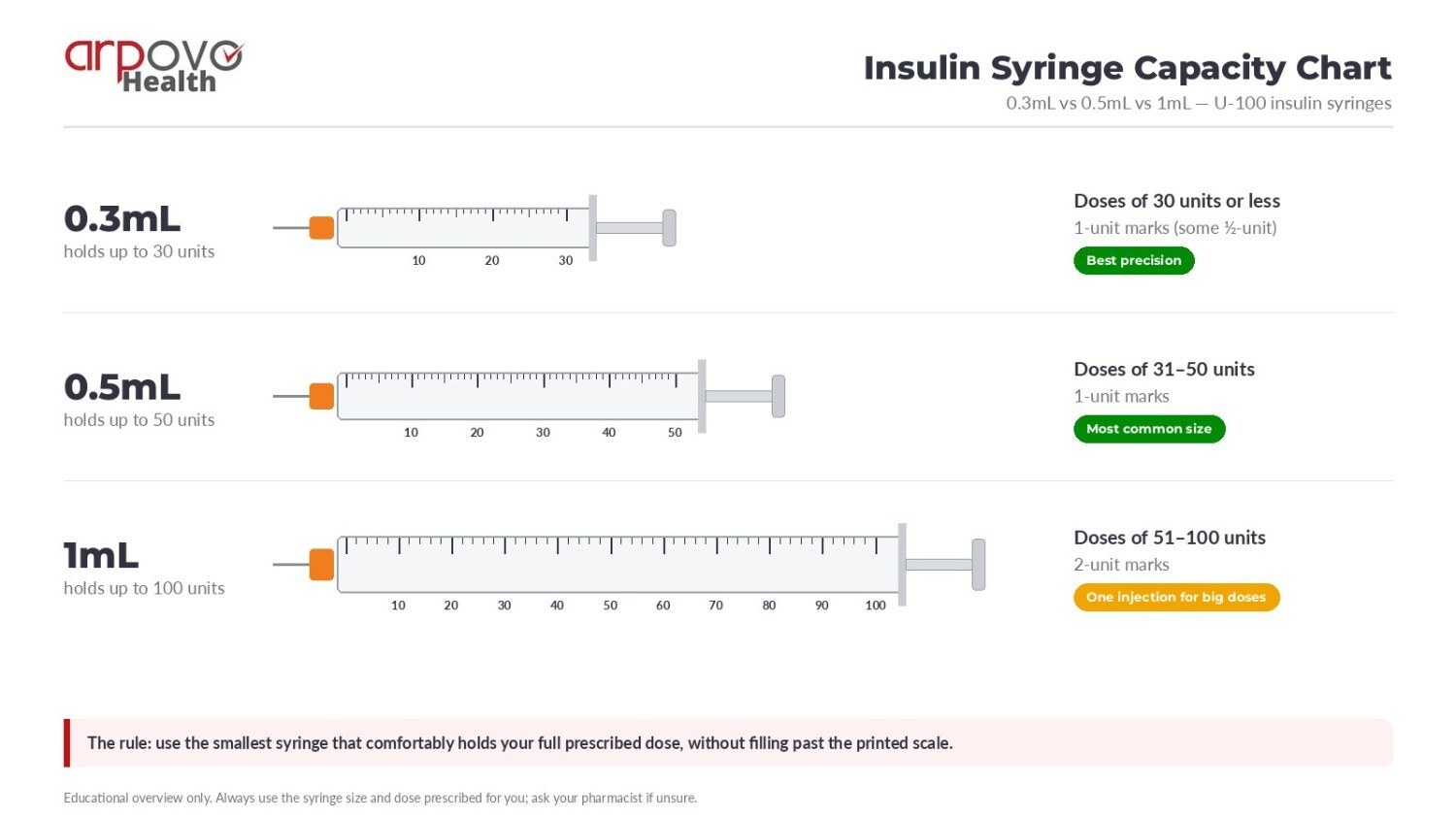
In a straight 0.3ml vs 0.5ml vs 1ml syringe comparison, the deciding factor is almost always your prescribed dose, not personal preference.
0.3mL (30-Unit) Syringes
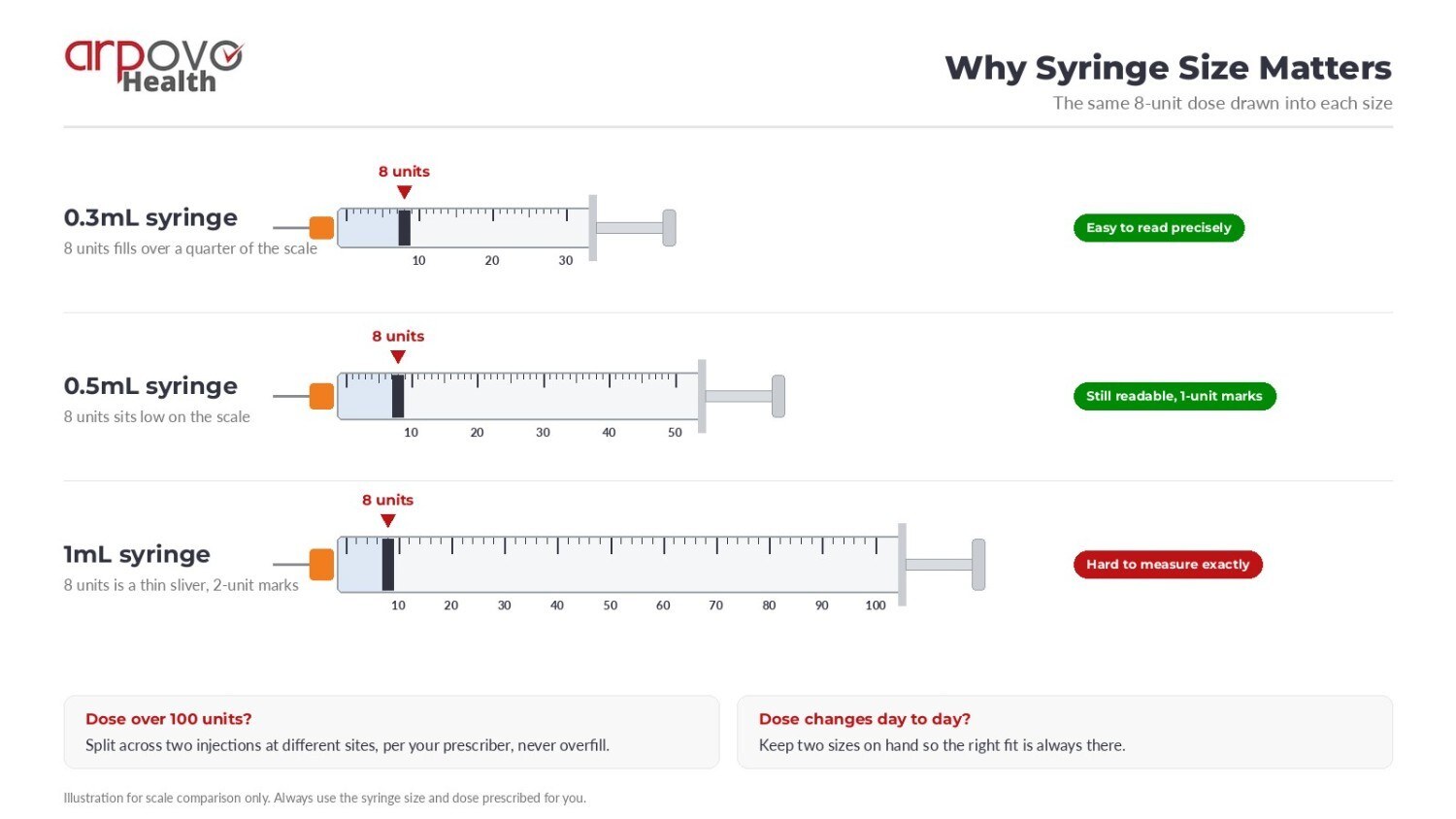
A 0.3mL syringe is the right choice for doses of 30 units or less. The smaller barrel spreads unit markings further apart, which matters most for small children, newly diagnosed patients still adjusting doses, or anyone whose dose needs fine precision. A small daily dose, say 8 units, is easy to read precisely at this size. That same 8-unit dose would occupy only a tiny sliver of a 1mL barrel's scale, making it much harder to measure exactly.
0.5mL (50-Unit) Syringes
A 30 unit vs 50 unit syringe choice comes down to where your dose actually falls: a 0.5mL syringe covers doses of 31 to 50 units, and it's the most commonly prescribed and stocked size overall.
If you're not sure which size to keep on hand as a general-purpose option, this is a reasonable default. It's still marked in 1-unit increments, so precision stays good even though the barrel is larger than the 0.3mL size.
1mL (100-Unit) Syringes
A 1mL syringe holds doses of 51 to 100 units, letting you draw a larger dose in one syringe instead of splitting it. Someone with a 70-unit dose, for example, can draw the full amount in a single 1mL syringe rather than needing two separate injections with a smaller size, which means fewer needle sticks and less handling. The honest trade-off is precision: markings are spaced every 2 units instead of 1, which matters more if your dose sits at the lower end of this syringe's range, where a single misread line has a bigger relative effect on accuracy.
What If Your Dose Doesn't Fit Any Size Cleanly?
If your prescribed dose would exceed a syringe's printed scale, the standard approach is splitting it across two injections at different sites, following your prescriber's specific instructions, not overfilling past the marked line.
Some people keep two syringe sizes on hand if their dose varies day to day, such as with sliding-scale dosing, so they always have the right fit without needing to guess which size to reach for that day.
Once you know your size, browse Arpovo Health's full needles and syringes catalog to find it. Once you've got the right syringe in hand, the guide on reading the unit markings covers exactly where to look before you draw a dose.
Frequently Asked Questions
What size insulin syringe do I need?
It depends on your prescribed dose: 0.3mL for 30 units or less, 0.5mL for 31 to 50 units, and 1mL for 51 to 100 units. Choose the smallest size that comfortably fits your full dose.
Can I use a 1mL syringe for a small dose?
You can, but the wider spacing between unit markings on a 1mL syringe makes small doses harder to measure precisely than on a 0.3mL or 0.5mL syringe.
What should I do if my dose is higher than 100 units?
Following your prescriber's specific instructions, this typically means splitting the dose across two injections at different sites rather than overfilling a syringe past its printed scale.
Is a 0.5mL syringe a safe default if I'm not sure which size I need?
It's a reasonable middle-ground size and the most commonly prescribed, but always match syringe size to your actual prescribed dose rather than guessing. Check with your pharmacist if you're unsure.
Does syringe capacity affect needle gauge or length?
No, they're separate choices. Capacity is about how much the barrel holds; gauge and length are about needle thickness and how deep it delivers the dose. See the insulin syringe gauge guide for that decision.
(This article is for general educational purposes and isn't a substitute for advice from your doctor or pharmacist. Always use the syringe size and dose specifically prescribed for you.)