
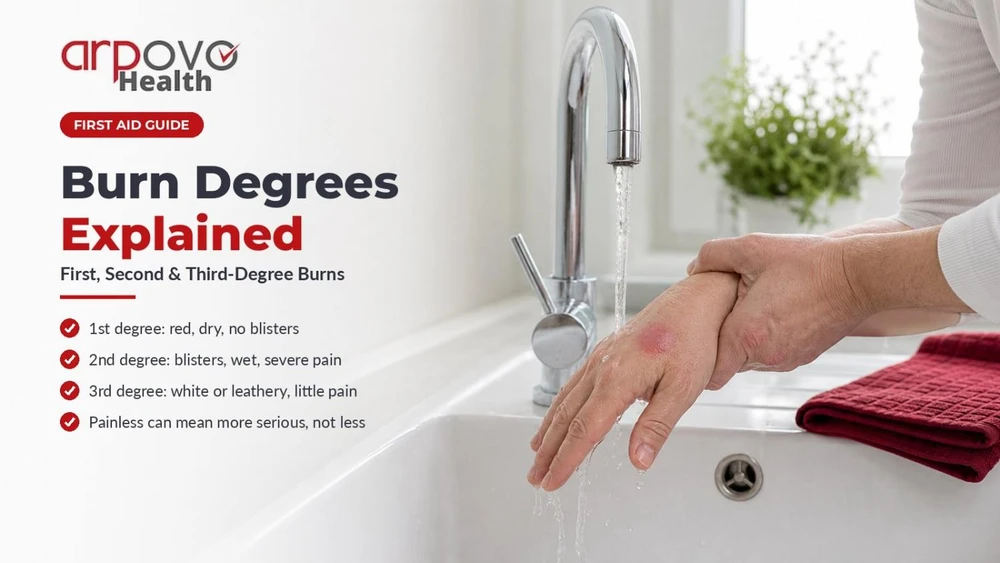
Burn Degree Identification: First, Second, and Third-Degree Burns Explained
Sep 14th 2026
Degrees of burns explained simply: burn degree, not size or pain level alone, determines whether a burn needs home care or emergency treatment. First-degree burns affect only the outer skin layer. Second-degree burns go deeper and blister. Third-degree burns destroy the full thickness of skin and always need emergency care. If you're dealing with a burn right now, use the table below to quickly identify what you're looking at, then check the emergency-care checklist near the end regardless of degree.
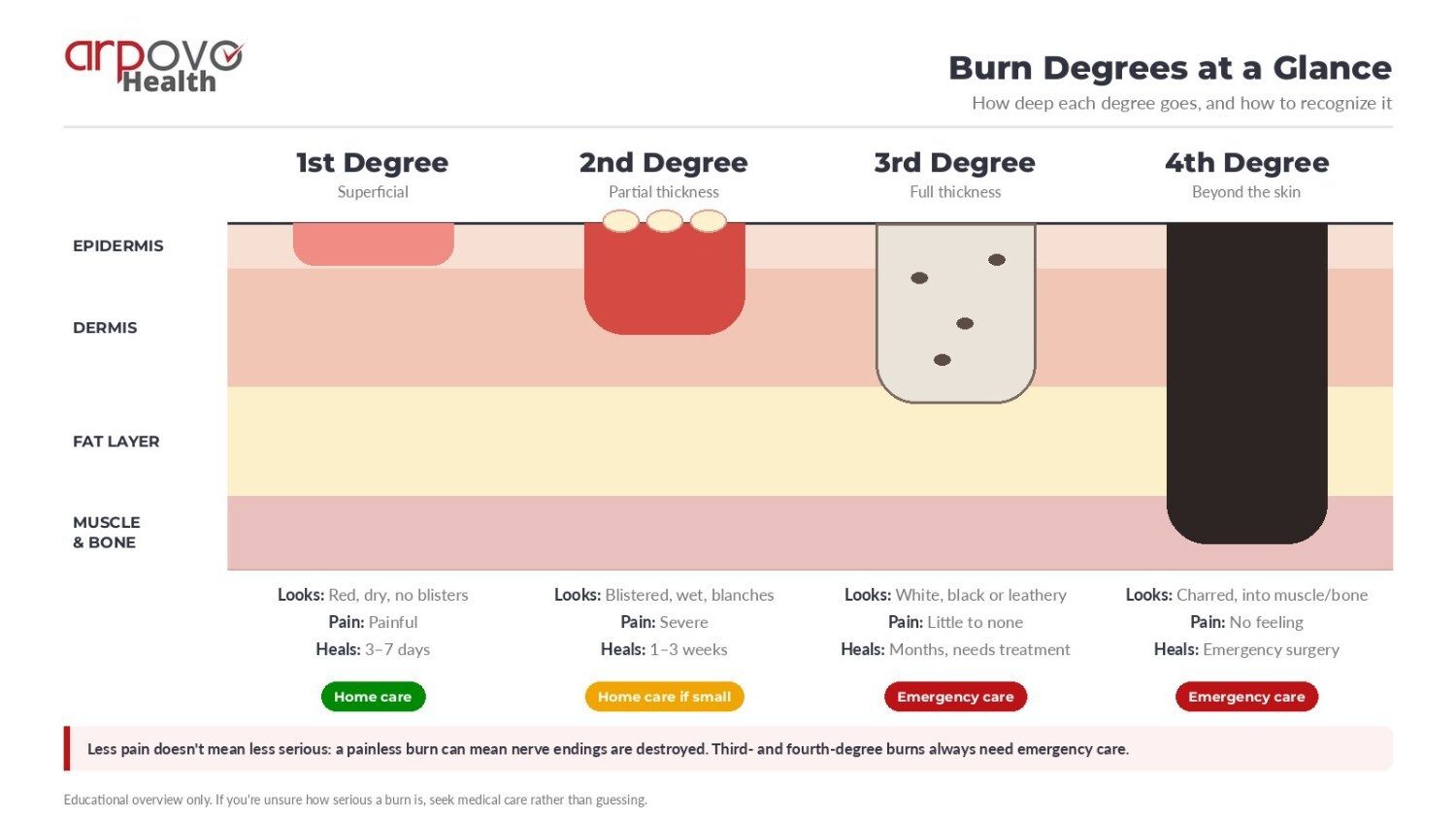
Quick Reference: Burn Degrees at a Glance
|
Degree |
Appearance |
Pain Level |
Typical Healing Time |
|
First (superficial) |
Red, dry, no blisters |
Painful |
3–7 days |
|
Second (partial thickness) |
Red/blotchy, blistered, wet or weeping, blanches when pressed |
Severe pain |
1–3 weeks |
|
Third (full thickness) |
White, blackened, or leathery; does not blanch |
Little to no pain nerve endings destroyed |
Months; requires medical treatment |
|
Fourth |
Charred, extends into muscle, tendon, or bone |
No feeling in the area |
Requires emergency surgical care |
Why Burn Degree Matters
Burn degree, more than size or how much it hurts, determines whether a burn is appropriate for home care or needs emergency treatment. Knowing how to tell what degree a burn is starts with two things: how it looks and how much it hurts and sometimes, counterintuitively, how little it hurts. The sections below walk through each degree by appearance first, since that's what you need to identify right now.
First-Degree Burns (Superficial)
A first-degree burn affects only the outer layer of skin: red, dry, and painful, with no blisters. These are the mildest burns and typically heal in 3 to 7 days with home care: cool (not ice-cold) water, aloe vera, and an over-the-counter pain reliever if needed.
Second-Degree Burns (Partial Thickness)
Telling a first degree burn vs second degree apart mainly comes down to blistering: first-degree burns don't blister, second-degree burns do. Look for red or blotchy skin that's blistered, wet or weeping, and turns white briefly when you press it a response called blanching. Pain is significant. Healing typically takes 1 to 3 weeks. A small second-degree burn, roughly palm-sized or smaller and not on a sensitive area, is often manageable at home; a larger one needs medical evaluation. The size-estimation section below explains how to judge that.
Third- and Fourth-Degree Burns (Full Thickness and Beyond)
A third-degree burn destroys both layers of skin, and it always requires emergency care, no exceptions. The clearest third degree burn symptoms are appearance-based: skin that looks white, blackened, or leathery, and does not blanch when pressed. Pain is often minimal not because the burn is minor, but because the nerve endings in that area have been destroyed. Painlessness here is a warning sign, not a reassuring one. A fourth-degree burn goes further still, extending into muscle, tendon, or bone, with no feeling in the area at all. Both third- and fourth-degree burns are always a medical emergency; fourth-degree burns sometimes require surgery or amputation.
Estimating Burn Size: The Rule of Nines and Palm Method
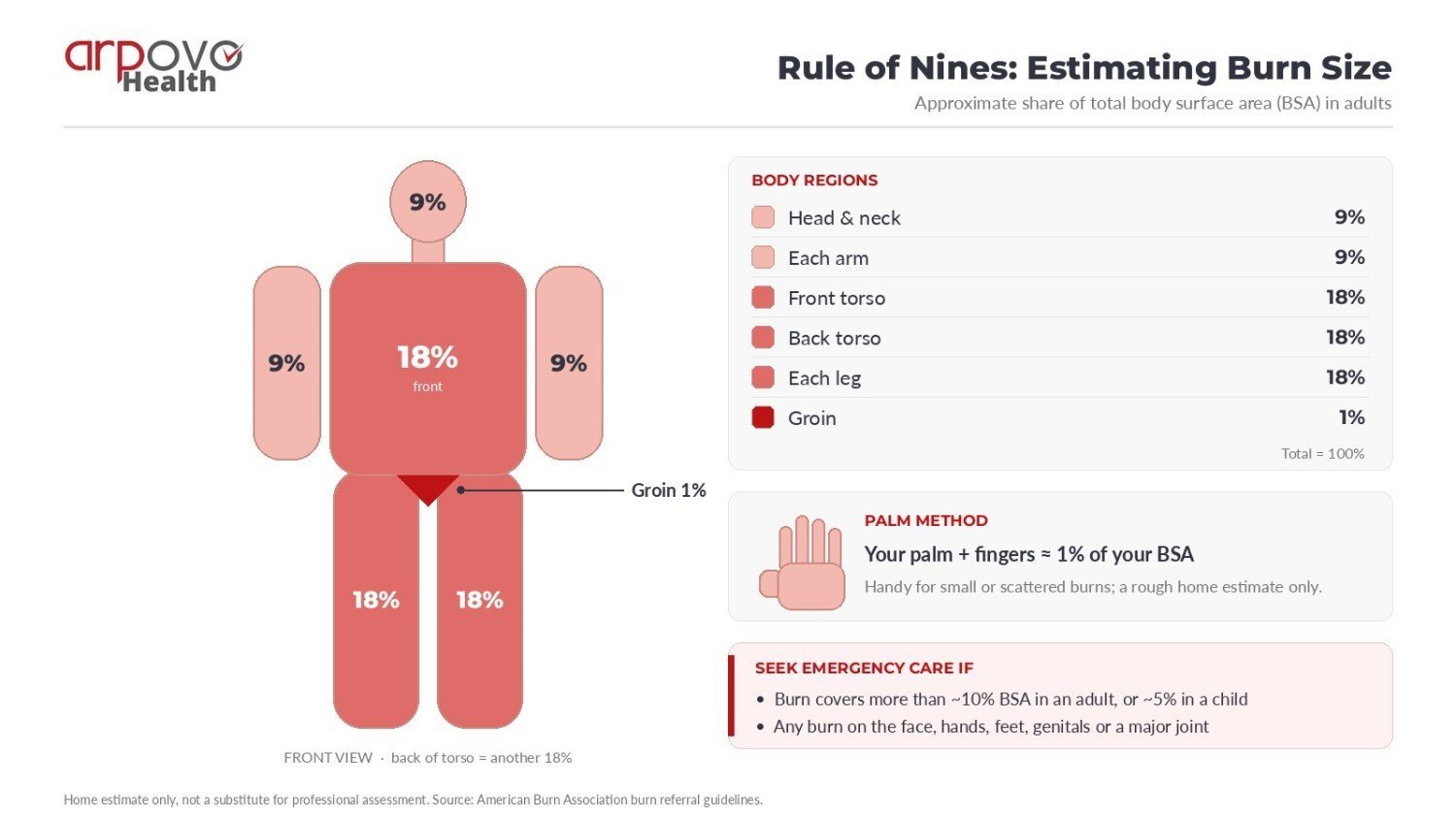
Clinicians estimate burn size using the Rule of Nines, and a simplified version works at home too. The adult body is divided into regions worth roughly 9% each (head and neck, each arm), 18% each (front torso, back torso, each leg), plus 1% for the groin. For a smaller or scattered burn, your own palm plus fingers stands in for roughly 1% of your body surface area. This is a quick way to estimate size at home, not a replacement for a professional assessment.
When to Seek Emergency Care Regardless of Degree
Seek emergency care immediately if any of the following apply, regardless of what degree you think the burn is:
- Any third- or fourth-degree burn
- A burn larger than about 10% of body surface area in an adult (roughly the size of your own two palms together), or about 5% in a child, as a general guideline
- Burns on the face, hands, feet, genitals, or a major joint
- A burn that wraps all the way around a limb
- Any chemical, electrical, or inhalation-related burn
If any of these apply, get medical care now rather than continuing to read. The American Burn Association's referral guidelines cover this in more clinical detail if you want the source.
Frequently Asked Questions
How can I tell if a burn is first, second, or third-degree?
Look at appearance and pain: first-degree is red and painful with no blisters; second-degree has blisters and weeps; third-degree looks white, blackened, or leathery and is often less painful because nerve endings are damaged.
Why is a painless burn actually a warning sign?
Reduced pain can mean the burn has destroyed nerve endings in the skin, which happens in third-degree burns. Painlessness doesn't mean the burn is minor it can mean the opposite.
What size burn requires emergency care?
As a general guideline, any burn larger than about 10% of body surface area in an adult (or 5% in a child) needs emergency evaluation, along with any burn on the face, hands, feet, genitals, or a major joint, regardless of size.
Can I treat a second-degree burn at home?
Small second-degree burns, roughly palm-sized or smaller and not on a sensitive area, are often manageable at home. Larger second-degree burns, or ones in sensitive locations, need medical evaluation.
What's the difference between third- and fourth-degree burns?
Third-degree burns destroy the top two layers of skin. Fourth-degree burns go further, extending into muscle, tendon, or bone. Both always require emergency medical care.
If your burn is minor and appropriate for home care, Medihoney and other advanced wound dressings can support healing the guide on using Medihoney in emergency situations covers that specific next step. Either way, browse Arpovo Health's full wound care catalog for supplies.
This article is for general educational purposes and isn't a substitute for professional medical evaluation. If you're unsure how serious a burn is, seek medical care rather than guessing.