
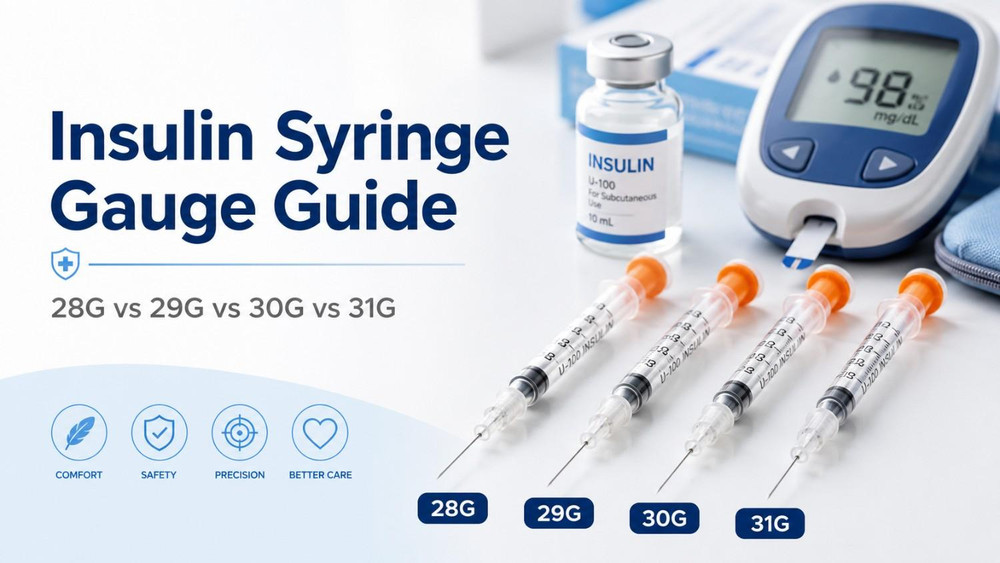
Insulin Syringe Gauge Guide: 28G vs 29G vs 30G vs 31G Which Should You Use?
Jul 17th 2026
If you use insulin syringes, you have probably noticed a number followed by the letter G printed on the box. That number describes the insulin syringe gauge sizes available for injecting insulin, and it tells you how thick or thin the needle actually is. The four most common sizes are 28G, 29G, 30G, and 31G. Each one balances comfort against speed in a slightly different way. This guide compares all four so you can talk with your provider about which gauge fits your daily routine.
Browse the reliable insulin syringes!
What Does "Gauge" Mean, Exactly?
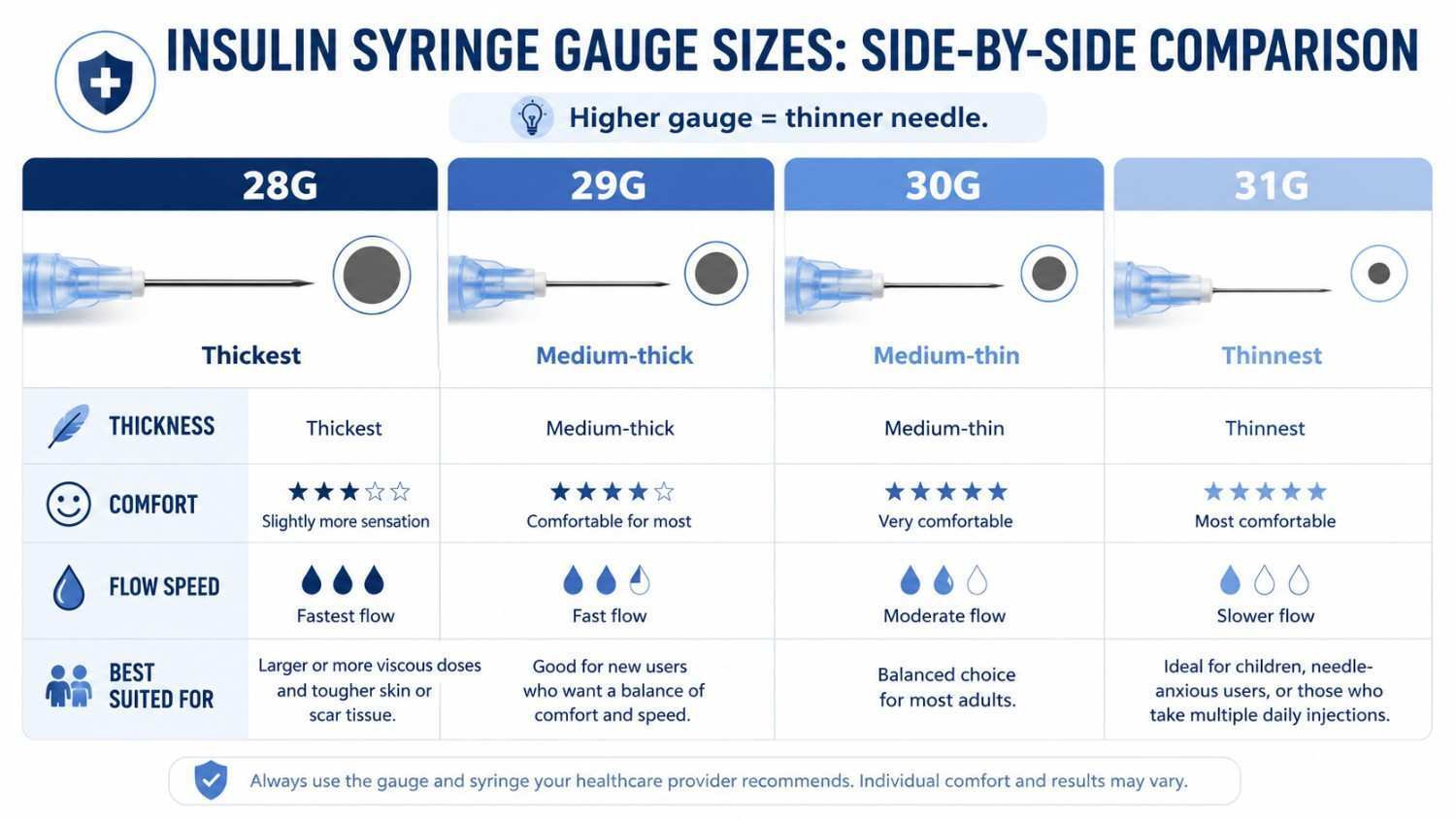
Gauge measures the width of a needle, not its length. Here is the short version of insulin needle sizes explained: the higher the gauge number, the thinner the needle. A 31G needle is thinner than a 28G needle, even though 31 is the bigger number. Picture two drinking straws. A wide straw empties a milkshake quickly. A narrow cocktail straw sips more slowly but feels gentler in your mouth. Insulin needles work the same way. Thicker gauges push insulin through faster. Thinner gauges feel softer against the skin, though they take slightly longer to finish the injection.
Insulin Needle Gauge Chart: 28G vs 29G vs 30G vs 31G
This insulin needle gauge chart lines up all four sizes side by side. It covers thickness, comfort, flow speed, and who each size tends to suit best.
|
Gauge |
Relative Thickness |
Typical Comfort |
Flow Speed |
Best Suited For |
|
28G |
Thickest of the four |
Good, slightly more sensation |
Fastest |
Larger or viscous doses, thicker skin or scar tissue, frequent large-volume injections |
|
29G |
Medium-thick |
Comfortable for most |
Fast |
People new to insulin who want reliable, quick delivery |
|
30G |
Medium-thin |
Very comfortable |
Moderate |
Most adult users; a common balanced choice |
|
31G |
Thinnest |
Most comfortable |
Slower |
Needle-anxious users, children, multiple daily injections |
As a rough guide, a 28G needle measures close to 0.36mm across, while a 31G needle measures closer to 0.25mm. Manufacturers vary slightly on exact diameter, so treat these numbers as general ranges, not fixed specs.
28G Needles
A 28G needle is the thickest option on this list, built for speed rather than subtlety. Because the bore is wider, insulin flows through quickly. That matters if you take a larger dose or use a more viscous type of insulin. People with thicker skin or scar tissue from years of injecting often prefer 28G, since a thinner needle can sometimes struggle to get through toughened tissue. The trade-off is sensation. A 28G needle produces slightly more feeling on entry than the thinner sizes below it. Most users still describe it as quick, not painful.
29G Needles
The 29G needle sits in the middle of the range. It is thinner than 28G but still fast enough for reliable dosing. This size works well as a starting point for people who are new to insulin therapy. It delivers insulin at a solid pace while feeling noticeably gentler than 28G. If your provider has not specified a gauge and you are unsure where to begin, 29G is a safe, well-rounded choice. It suits most standard doses without asking you to give up much speed or comfort.
30G Needles
Moving down to 30G, the needle is thinner still, and for many adults it lands in the sweet spot between comfort and speed. In a straightforward 28G vs 30G insulin needle comparison, the 30G wins on comfort almost every time, while the 28G keeps a slight edge on speed. Most people barely notice the difference in how long an injection takes. That is one reason 30G has become a common default for adults who inject once or several times a day. If you currently use a thicker gauge and want an easy upgrade in comfort, 30G is often the first size worth trying.
31G Needles
At 31G, you reach the thinnest insulin needle on this list, and most people find it the most comfortable option available. The narrow bore means less resistance entering the skin. That is why 31G is often recommended for children, needle-anxious adults, or anyone injecting several times a day. Flow speed is the slowest of the four gauges, but for small to moderate insulin doses, the slowdown is barely noticeable. If comfort is your top priority and your dose fits within a standard syringe, 31G is worth asking your provider about.
Gauge Isn't the Only Number That Matters: Needle Length Counts Too
Gauge controls thickness, but needle length controls how deep the insulin goes. Both numbers matter together. Needle length typically ranges from about 4mm to 12.7mm, depending on the syringe or pen needle you choose. A length that is too long for your body type can push insulin into muscle instead of the fatty tissue just under the skin, which changes how quickly it absorbs. If you have not settled on a delivery method yet, the comparison of insulin syringes and insulin pens covers that decision in more depth, and it is worth raising your needle length alongside your gauge choice at your next appointment.
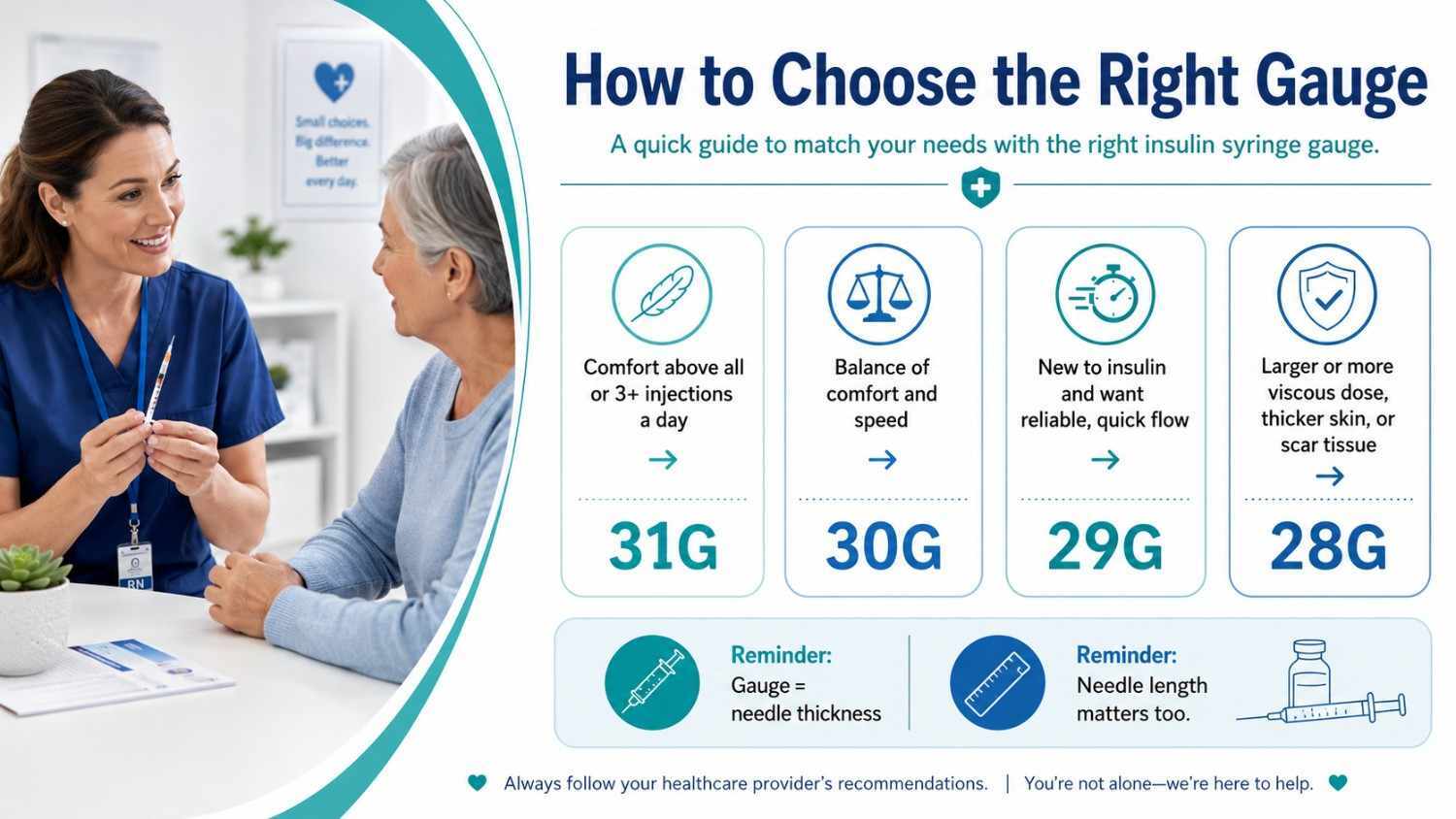
How to Choose: A Quick Decision Guide
The American Diabetes Association notes, gauge and length work together to determine comfort and proper insulin delivery. Choosing a gauge comes down to matching the needle to your priorities, whether that is comfort, speed, or a specific medical need. If you are asking which insulin needle is least painful, comfort-focused users almost always point to 31G, with 30G close behind.
- Comfort above all, or 3+ injections a day: consider 31G, the thinnest option available.
- A balance of comfort and speed: consider 30G.
- New to insulin and want reliable, quick flow: consider 29G.
- Larger or more viscous dose, thicker skin, or scar tissue: consider 28G.
Use the above given list as a helpful starting point for the conversation with your provider, who makes the final call based on your syringe capacity, insulin type, and injection routine.
Once you know which gauge fits your routine, the next step is finding syringes that are actually in stock and easy to reorder. Arpovo Health stocks EasyTouch and SOL-M insulin syringes across all four common gauges, so you can compare options and stick with what works for you. Browse the full range of insulin syringes with needles to see current sizes and packaging.
Frequently Asked Questions
Is a higher gauge needle more painful?
No, it is the opposite. A higher gauge number means a thinner needle, which is generally more comfortable, not less.
What's the most common insulin needle gauge?
30G and 31G are the most widely used today, since most people prioritize comfort and typical insulin doses do not require faster flow.
Can I switch gauges without talking to my doctor?
You can typically choose your own gauge once your provider has confirmed your syringe capacity and needle length. It is still worth mentioning any change at your next visit.
Does needle gauge affect my insulin dose?
No, gauge affects comfort and how fast the insulin flows, not the amount of insulin delivered. Dose is controlled by how much you draw into the syringe.
Are thinner needles worse for larger insulin doses?
Not worse, just slower. For larger or more viscous doses, some people prefer a slightly thicker gauge, like 28G or 29G, simply to finish the injection a bit faster.